How to Start a Rap Career with Zero Money in 2027 (Step-by-Step Roadmap)
Most broke artists never drop a single song because they are waiting on money they don’t have. They think they need $500 for an engineer, $300 for an exclusive lease, and a videographer with a gimbal before anyone will take them seriously. That mindset kills more careers than bad bars ever will.
If you are trying to figure out how to start a rap career with no money, the good news is that the barrier to entry in 2027 has never been lower. Between free cloud-based recording software, producers handing out commercial rights for free just to build their catalogs, and smartphone cameras that shoot cleaner footage than music videos from ten years ago, you already have everything you need to get off the ground. What separates the artists who actually build a fanbase from the ones stuck in their notes app isn’t a trust fund—it’s execution and consistency.
Here is the real, zero-budget roadmap to recording your first tracks, shooting visuals that don’t look cheap, and building actual buzz in your city without spending a dime.
Turn Your Bedroom Into a Studio Using Free DAWs
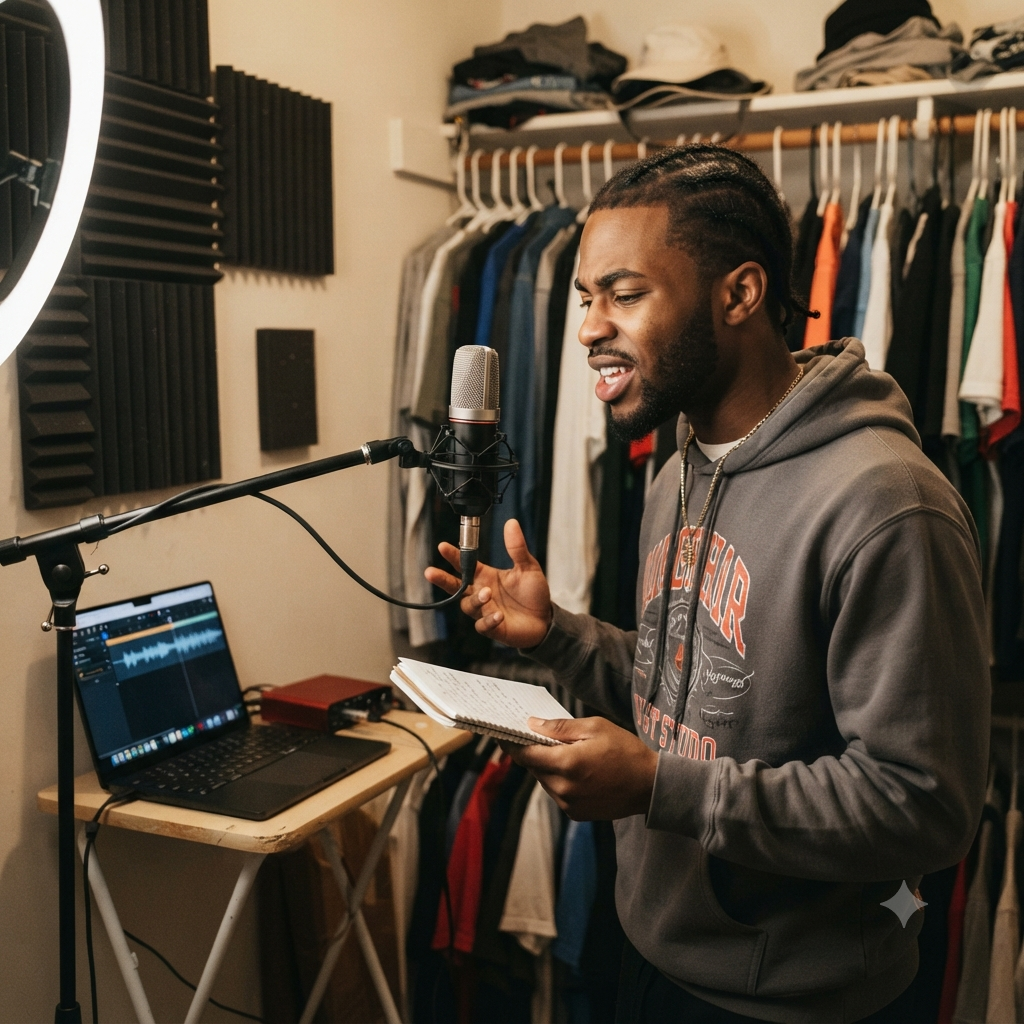
Paying $60 an hour at a local studio when you haven’t even found your vocal pocket yet is a fast way to go broke. When you record at home, you get unlimited takes. You can punch in line by line, experiment with different cadences, and figure out how your voice actually sits on a beat without watching a clock tick away.
You don’t need pirated software or expensive hardware to make this happen:
-
BandLab (Mobile & Browser): If all you have is a smartphone or an older laptop, start here. BandLab is completely free, runs in the cloud, and comes loaded with multi-track recording, built-in vocal presets, EQ, compression, and free mastering tools that get your tracks loud enough for streaming platforms.
-
Cakewalk Sonar (Windows PC): If you’re working on a Windows computer, Cakewalk Sonar offers a free tier that gives you a legitimate desktop Digital Audio Workstation. Unlike basic mobile apps, it supports third-party VST plugins, meaning you can dial in clean, radio-ready vocal chains using free online plugins.
Your room matters way more than your microphone. An untreated bedroom with bare drywall will make a $1,000 mic sound hollow and echoey. Step inside a walk-in closet packed with hanging clothes—all that fabric acts as natural acoustic treatment and absorbs reflections. Put on a pair of standard wired earbuds to hear the beat (skip Bluetooth headphones since latency will throw off your timing), hold your phone’s mic about six to eight inches from your mouth at a slight angle so your P’s and B’s don’t pop, and start tracking.
Stop Ripping Beats and Use “Free-for-Profit” Instrumentals Properly
Nothing stalls momentum faster than dropping a song you love only to watch Spotify or YouTube pull it down over a copyright strike. Downloading a beat off YouTube through a sketchy MP3 converter and uploading it to streaming services is amateur hour, and it ruins relationships before you even start.
Instead, dig into the massive economy of free-for-profit beats. Hungry producers upload thousands of instrumentals every week on YouTube and BeatStars under free-for-profit licenses because they want artists to catch a buzz on their sound.
| Where to Look | How to Filter | What to Check Before Uploading |
| YouTube | Search [Artist/Style] type beat free for profit 2027 |
Read the description carefully. “Free for non-profit” restricts you to SoundCloud or YouTube; “free for profit” lets you monetize on Spotify and Apple Music up to a set stream cap. |
| BeatStars | Filter results by Free Downloads |
Download the free tagged MP3 directly from the producer’s page so you have a record of the license terms. |
| BandLab Sounds | Browse the built-in loop and beat packs | 100% royalty-free and cleared for commercial distribution with zero restrictions. |
Whenever you use a free-for-profit beat, treat the producer like a partner. Put (Prod. by [Producer Name]) directly in your official song title, tag them when you post snippets on Instagram and TikTok, and DM them a link when the record goes live. Producers deal with hundreds of rappers who download their beats and never drop anything. When you actually execute, mix it well, and give proper credit, producers will frequently start sending you exclusive, untagged beat packs for free.
Shoot 4K Smartphone Visuals in Natural Daylight
Nobody clicks on a static cover art video anymore. In 2027, short-form vertical video across TikTok, Instagram Reels, and YouTube Shorts is how new fans discover your music. You do not need a cameraman, a rented foreign car, or colored LED lights in a dark basement. In fact, dark rooms are the worst place to film because smartphone camera sensors get grainy and muddy the second they lose light.
Your best lighting rig is free and sits outside every single day.
Go outside during Golden Hour—roughly the first hour after sunrise or the last hour before sunset—or film in open shade on an overcast afternoon. Natural daylight makes smartphone footage look crisp, sharp, and high-contrast. Before you hit record, wipe your camera lens with your shirt, switch your phone’s video settings to 4K at 30fps (or 24fps if you want a slightly more cinematic feel), and tap your face on the screen to lock your focus and exposure so the brightness doesn’t flicker while you move.
Keep the energy moving. Walk down an interesting block, lean against concrete architecture in an empty parking garage, or film from a low angle looking up. Shoot three or four full performance takes from different spots, chop the clips every two to three seconds so the visual keeps pace with your delivery, and slap clean, readable captions on the screen. If people scrolling on mute can read a clever punchline, they’ll tap to hear how you delivered it.
Build Real-World Leverage at Local Open Mics
Chasing algorithms alone can feel like screaming into a void. If you want to know how to start a rap career with no money and actually build fans who care, get off your phone and hit local open mics. Performing live is the fastest way to sharpen your breath control, test which hooks actually make heads nod, and turn strangers into real supporters.
Start searching Eventbrite, local venue calendars, and Instagram tags like #[YourCity]OpenMic or #[YourCity]HipHop to find weekly showcases at coffee shops, lounges, and indie bars. Most of them are free to sign up if you get there early.
When it’s your turn on stage, don’t make the rookie mistake of rapping over your full studio track with the lead vocals still playing. Export a show mix—just the instrumental with your hook backing vocals and ad-libs—and bring it on both a USB drive and your phone with the right adapter. Get on the mic, state your name and social handle clearly once, and deliver your sharpest 16 bars with eye contact and real projection. Afterward, don’t dip out immediately. Stick around, show genuine love to the other performers, introduce yourself to the host and DJ, and trade Instagrams with people in the crowd. Ten real fans from your own city who share your music mean way more than a thousand passive bot views.
Distribute for Free and Scale Your Reach
Once you have three to five solid tracks recorded, road-tested at open mics, and backed by short-form performance clips, get them onto major DSPs without paying upfront fees. Free-tier distributors like RouteNote, Amuse, and BandLab Distribution let you push your singles to Spotify, Apple Music, TikTok, and Instagram while letting you keep 100% of your master rights (they simply take a small percentage of royalties in exchange for zero upfront cost).
Commit to a steady release schedule—one quality single every three to four weeks, supported by ten to fifteen short video clips per track. Consistency compounds. Once you build your initial grassroots momentum, scale your reach efficiently with our artist submission portal (https://itshiphopmusic.com/submit/artist-submission/).