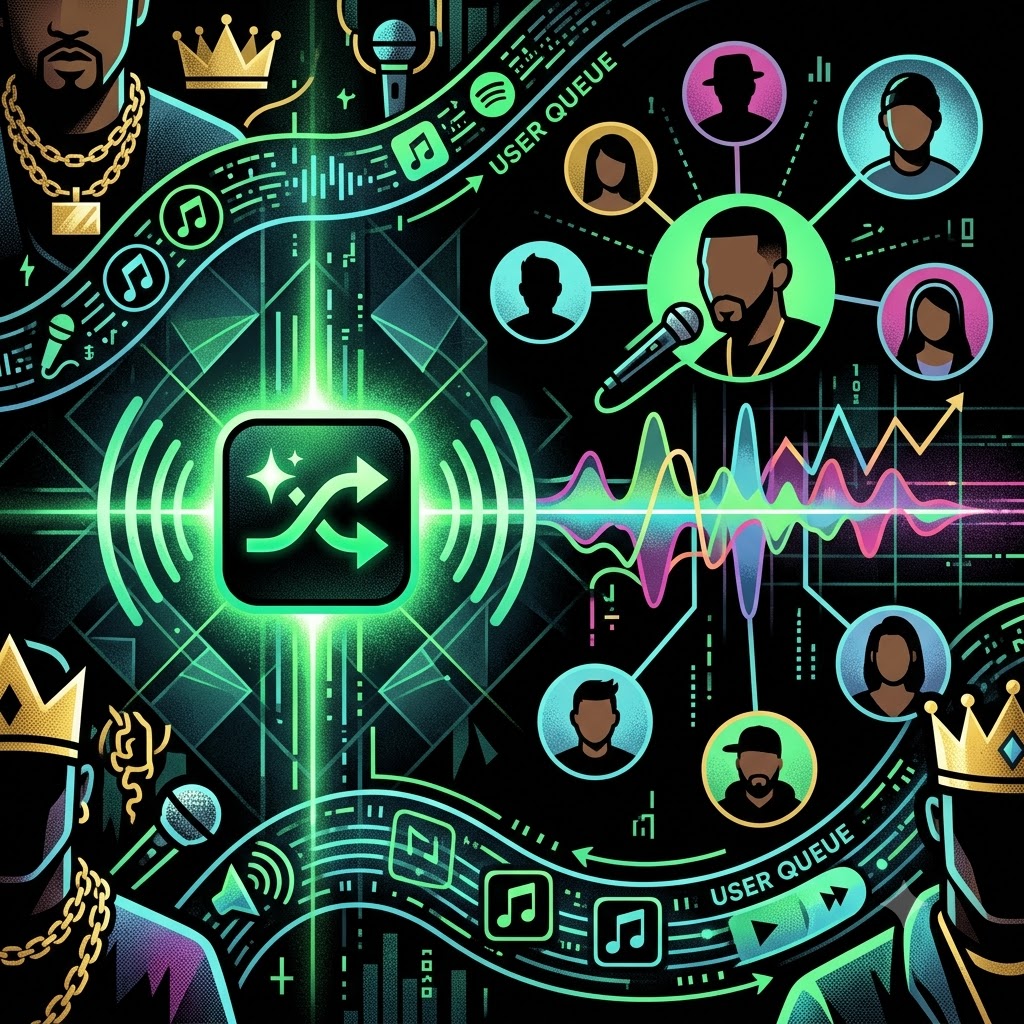
How Spotify’s “Smart Shuffle” Injects Competitor Rap Tracks into User Queues (And How to Hijack It)
If you’ve ever thrown on a custom playlist of your favorite underground boom-bap records or dark trap bangers, hit shuffle, and suddenly heard an artist you’ve never heard of before, you’ve experienced Smart Shuffle.
For everyday music fans, it feels like magic—a simple tool to keep the music flowing without having to build a 200-song playlist. But if you’re an independent rap artist, producer, or indie label owner, Smart Shuffle is a high-stakes algorithmic arena. It’s easily one of the most effective recommendation pipelines on Spotify today. When you know how the system decides what plays next, you can position your music so it gets slipped right into the queues of your biggest competitors’ fans.
Let’s unpack how Spotify’s recommendation engine works behind the scenes, how behavioral science plays into song placement, and how you can tune your sound to hijack your rival’s fanbase.
What Spotify Smart Shuffle Actually Does Behind the Scenes
Back in the day, pressing shuffle meant Spotify picked a random track from the playlist you were playing. At most, it ran a simple script to prevent the same artist from playing twice in a row.
Smart Shuffle changed the rules entirely. Instead of just organizing the tracks already in a playlist, it actively injects new, recommended tracks—marked with that little green sparkling icon—right into the user’s queue.
Spotify doesn’t pull these songs out of thin air. The algorithm looks at what’s currently playing, analyzes the mood, and scans its library to find songs that fit the vibe seamlessly. For independent hip-hop artists, this creates a major opportunity: if your song matches the audio profile of a popular rap track, Spotify will use Smart Shuffle to hand-deliver your record to an active listener without you ever paying for a placement.
The Behavioral Science & Algorithmic Triggers Behind Smart Shuffle
Getting injected into someone else’s queue isn’t about luck. Spotify relies on complex audio processing and user psychology to decide which song gets the nod.
       [ Playlist Audio Profile ]
                   │
                   ▼
       [ Acoustic Vector Matching ]
  (Tempo, Energy, Frequency, Vocal Balance)
                   │
                   ▼
       [ Smart Shuffle Injection ]
                   │
                   ▼
      ┌────────────┴────────────┐
      ▼                         ▼
 [ Skip < 30s ]           [ Stream > 30s ]
  Negative Signal          Positive Signal
  (Decreases Reach)       (Pushes to Similar Queues)
1. Acoustic Vector Proximity (Audio Mapping)
Before a song ever gets recommended, Spotify scans the audio file. It breaks down every track into raw data points like tempo, key, energy levels, danceability, and acoustic characteristics.
Imagine a giant 3D map of every song on the platform. Songs that sound similar sit close together on this map:
-
If a fan is playing heavy, distorted, 140 BPM Atlanta trap, Spotify looks at songs located in that exact cluster.
-
If your track shares the same low-end weight, vocal presence, and drum arrangement as the songs on that playlist, Spotify considers your track a low-risk option to inject into the queue.
2. The 30-Second Rule and Listener Psychology
Smart Shuffle relies heavily on real-time feedback. When a listener is in the zone—working out, driving, or playing video games—they usually don’t look at their phone unless a bad song breaks their focus.
If Spotify injects your track and the listener lets it play for more than 30 seconds without hitting skip, the algorithm marks that as a success. If they save the song or add it to their own playlist, that signal gets even stronger. The algorithm takes that data and starts showing your track to other users with similar listening habits.
3. Collaborative Filtering (Fan Micro-Clusters)
Spotify also looks at listener habits as a group. If 50 people who listen to an established rapper like Baby Keem also listen to your recent single, Spotify’s collaborative filtering engine takes notice.
It connects the dots and realizes that fans of that specific style enjoy your sound. From there, Smart Shuffle starts recommending your music to thousands of other Baby Keem fans who haven’t discovered you yet.
How to Optimize Your Tracks to Get Injected into Competitor Queues
You can’t trick the algorithm with clickbait titles or fake plays. If you want Spotify to pick up your music for Smart Shuffle, your tracks need to match the technical and musical standards of your sub-genre.
1. Dial In Your Mix and Loudness Levels
If your song gets injected into a queue right after a professionally mixed track from a major label, it needs to stand toe-to-toe in quality. If your low-end is muddy or your vocals are quiet, the listener will hit skip immediately.
-
Target Commercial Loudness: Aim for -9 to -11 LUFS integrated for modern rap and trap singles. This keeps your volume consistent with top-performing industry tracks.
-
Tighten Your Low End: Modern rap relies on clean 808s and crisp kick drums. Make sure your bass frequency sits cleanly in the mix without drowning out the vocals.
2. Match the Genre Tempo and Structure
Study the artists whose fans you want to target. What BPM do they usually record at? How fast do their hooks hit?
If your goal is to land in queues alongside dark, fast-paced drill music, releasing a slow, melodic 85 BPM track won’t work. Keep your tempo, energy, and song structure in line with the current sound of that specific sub-genre.
3. Trim Long Intros
With Smart Shuffle, you have about 5 seconds to grab the listener’s attention before they check their phone. Skip the 30-second movie quotes, quiet atmospheric build-ups, or long instrumentals at the start of your track.
Get straight to the point. Start with a catchy vocal line, a recognizable producer tag, or a strong beat drop to keep the listener from hitting the skip button.
Seeding the Algorithm with Initial Data
The algorithm needs real listener data to start making connections. If your song has zero streams and no playlist saves, Spotify won’t know where to place it on its audio map.
To kickstart this process, you need real hip-hop fans streaming, saving, and sharing your music. Once you get those initial positive signals from active listeners, the recommendation engine takes over and starts expanding your reach automatically.
If you want to skip the slow grind and give your catalog the early push it needs, you can force your catalog into active recommendation queues through our independent music promo network.
Final Thoughts
Spotify’s Smart Shuffle isn’t just a convenience for listeners—it’s one of the best tools independent artists have for organic growth. Instead of relying purely on static playlist placements, you can train Spotify’s recommendation engine to work like an automated marketing team for your music.