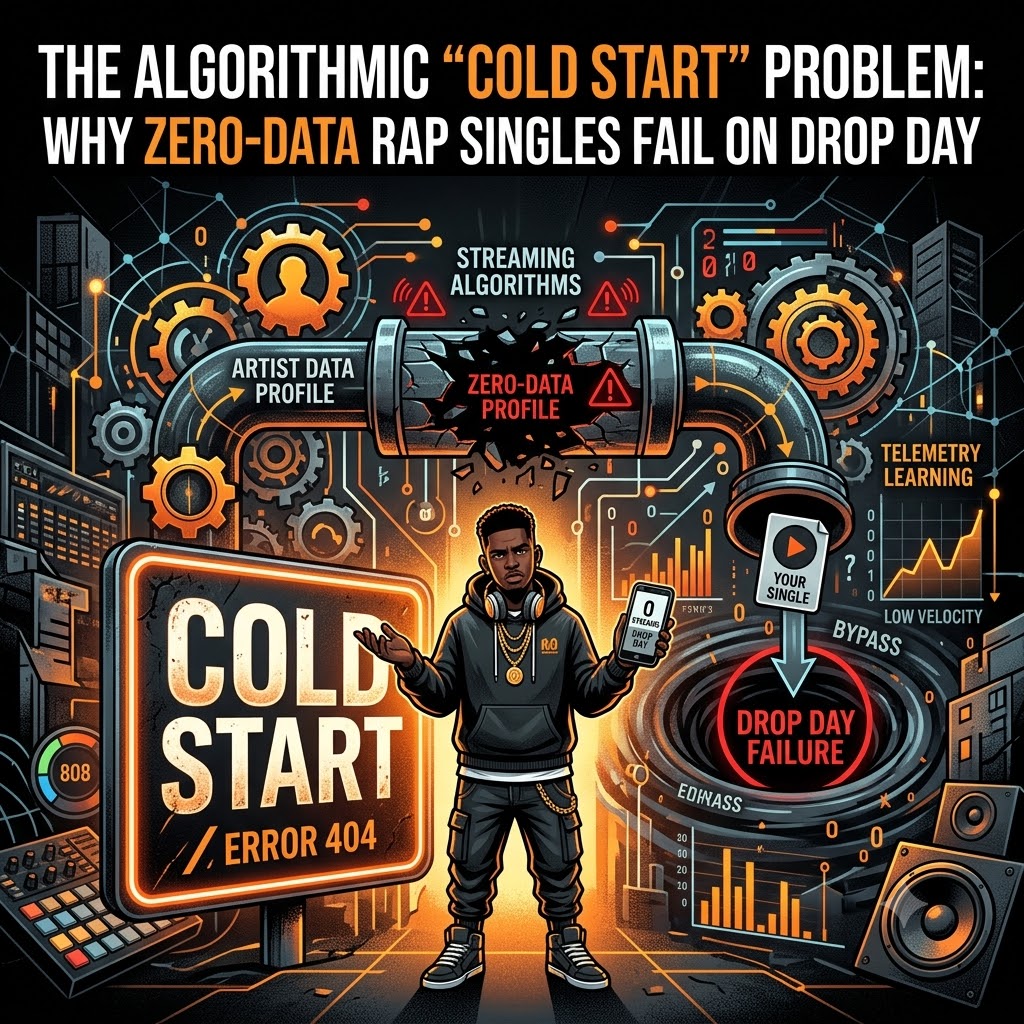
The Algorithmic “Cold Start” Problem: Why Zero-Data Rap Singles Fail on Drop Day
You spent two months getting the mix right, dialing in the sub-bass so it rattles car speakers without muddying the vocal, and dropping hard-earned cash on a clean master. You schedule the release, set up your pre-save, and refresh Spotify for Artists at midnight on Friday expecting to see numbers climbing.
Instead, you get crickets.
By Sunday evening, your stream count is stuck in double digits, mostly driven by your close friends and family. It’s frustrating, disheartening, and easy to blame on “cliques,” lack of connections, or an oversaturated market.
While those factors play a role, the immediate reason your track died on drop day isn’t politics. It’s mathematics.
In modern streaming, your music doesn’t just compete against other rappers—it competes against recommendation engines built on complex machine learning models. When you upload a track without an established audience backing it, you run directly into a classic data science wall known as The Cold Start Problem.
What Is the “Cold Start” Problem in Music Streaming?
To understand why your song isn’t getting pushed, you have to understand how digital service providers (DSPs) like Spotify, Apple Music, and YouTube Music operate.
At their core, these platforms aren’t record labels or tastemakers; they are retention engines. Their main priority is keeping users inside the app for as long as possible. To do that, they rely on recommendation software that predicts what a listener wants to hear next.
In machine learning, the “cold start problem” happens when a system tries to make accurate recommendations for a brand-new item that has zero historical data.
When Drake or Lil Baby drops a surprise single, the algorithm already has millions of historical data points attached to their artist profile. The system knows exactly who listens to them, when they listen, how long they stay tuned in, and what tracks they queue up right after. The system can confidently throw that new song onto personalized playlists like Release Radar or algorithmic radio stations with almost zero risk of the user closing the app.
When an independent artist drops a single with low or nonexistent profile velocity, the recommendation engine hits a blank wall. It has no telemetry, no listener clusters, and no engagement history to work with.
Because the algorithm is built to minimize risk, it defaults to caution: it simply bypasses your song and pushes tracks that already have proven data attached to them.
How DSP Algorithms Actually Analyze Your Music
A common myth among independent artists is that Spotify or Apple Music “listens” to your song, realizes it’s fire, and naturally pushes it to people who like good hip-hop.
The reality is much colder. While DSPs do use audio analysis tools to map out BPM, key, and basic dynamic range, these structural details only account for a tiny fraction of how recommendations are made. The overwhelming majority of an algorithm’s decisions come down to user telemetry and behavioral metrics.
Here are the specific signals the algorithm measures on drop day—and why a zero-data drop fails every single one:
1. The 30-Second Rule and Completion Rates
Streaming services only count a stream once a user reaches the 30-second mark, but their algorithms track user behavior down to the millisecond.
If a song is served to 50 random listeners via a small test batch and 35 of them hit “next” within the first 10 seconds, the algorithm flags that track immediately. To a machine learning model, a high early-skip rate isn’t a matter of taste—it’s a signal that the content is low-quality or misaligned with the audience. Once that flag is planted, the system throttles the track’s algorithmic reach to protect the user experience.
2. Collaborative Filtering and User Clustering
Collaborative filtering is the backbone of modern recommendation systems. It works by identifying overlaps in user behavior.
For example, if Listener A and Listener B both regularly stream the same 30 underground rap artists, the system assumes they have identical taste. If Listener A starts heavy-rotating a new underground single, the system will test that single on Listener B.
When you drop a track with no early traction, there are no behavioral bridges connecting your song to active listener clusters. The model literally doesn’t know who to play your music to, so it plays it to no one.
3. Save-to-Stream and Playlist Add Ratios
It’s not just about getting plays; it’s about what listeners do after the song ends. Algorithms weigh intentional actions heavily:
-
Saving the track to a personal library
-
Adding the track to a user-generated playlist
-
Looping or replaying the track in the same session
If a track gets 500 streams but zero saves or playlist additions, the algorithm assumes it was passive background noise. High-intent actions signal strong resonance, which prompts the model to test the track on a slightly larger cohort of listeners.
The Trap of Waiting for “Organic Discovery”
The biggest mistake independent rap artists make on release day is relying solely on passive, organic discovery inside the app. They post a link on Instagram, share a story, and hope the platform’s internal machinery takes over.
The problem with this strategy is that organic discovery on major streaming platforms is almost entirely gated by early data performance. If you don’t feed the algorithm positive signals within the first 24 to 72 hours of a release, your song gets buried beneath the 100,000+ new tracks uploaded to DSPs every single day.
You can’t wait for the platform to find your audience for you. You have to bring the audience—and the data—to the platform.
How to Beat the Cold Start Penalty on Release Day
To trick the algorithm into paying attention, you need to manufacture early listener velocity. You must feed the machine the exact behavioral metrics it hungers for: high completion rates, active saves, repeat plays, and real playlist inclusions.
When you seed a new release with targeted, engaged listeners right out of the gate, you generate a cluster of positive signals. The algorithm sees people listening past the 30-second mark, adding the song to their daily rotation, and saving it to their collections.
Once those fields are filled in, the system stops viewing your single as a high-risk, zero-data asset. It begins mapping your sound to similar artists and pushing your record into algorithmic ecosystem features like Discover Weekly, genre radios, and auto-play queues.
If you’re dropping new music soon, don’t let a lack of initial data sink an otherwise incredible project before it even gets off the ground. Seed your brand-new release with early listener data to bypass cold-start penalties using our curated rap playlists.