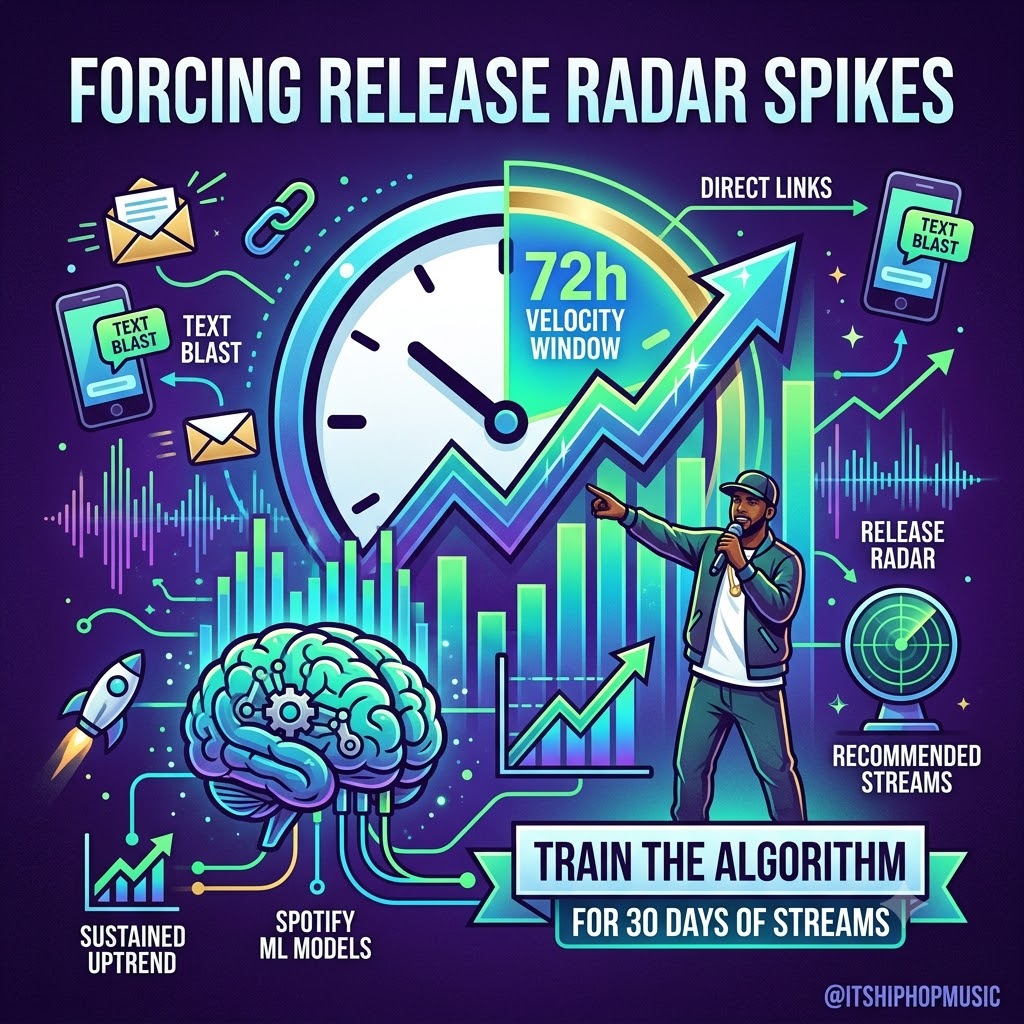
The 72-Hour Post-Release Velocity Window: How to Train Spotify’s Algorithm for 30 Days of Straight Streams
You’ve put in the real work. The mix is sitting right, the master slaps, and your distribution service has officially pushed your new track to Spotify. Release day hits, you post a couple of stories, send a link to your group chat, and sit back waiting for the platform to start pushing your song.
A few days go by. The stream counter barely ticks up. Your dashboard flatlines.
If this sounds painfully familiar, you aren’t alone—and it isn’t because your music sucks. You’re just falling into the trap of a passive release strategy. In today’s streaming landscape, dropping a song and hoping people magically stumble across it is the fastest way to get buried under the 100,000+ other tracks uploaded that exact same day.
Spotify doesn’t care how good your song is if nobody is listening to it right away. The platform’s systems don’t reward patience—they reward velocity.
If you want to trigger Spotify’s recommendation systems, land on Release Radar, crawl onto Discover Weekly, and keep a steady stream of new listeners coming in for a month straight, you have to change your approach. You need to focus almost all of your promotional energy on a tiny, critical timeframe: The 72-Hour Post-Release Velocity Window.
Here is what happens behind the scenes during those first three days, why driving outside traffic is the cheat code, and how you can use this window to force Spotify’s algorithm to work for you.
What Actually Is the 72-Hour Velocity Window?
Spotify’s algorithm isn’t a mysterious black box; it’s a massive set of machine learning models designed to keep users on the app as long as possible. To do that, the app needs to know which new releases are grabbing people’s attention and keeping it.
When your song drops, the system monitors it closely. But it isn’t just looking at how many people listen over a month. It’s looking at velocity—the speed, density, and concentration of engagement your track gets in the first 72 hours.
Think of it like a post on Instagram or TikTok. If you post a video and nobody interacts with it for six hours, the algorithm assumes it’s boring and stops showing it to people. But if 500 people like, comment, and share it within ten minutes, the platform goes, “Hold on, something is happening here,” and pushes it to thousands more.
Spotify works the exact same way. Your opening 72 hours are essentially a high-stakes test. If you can create a massive spike in user activity right out of the gate, you trick the algorithm into thinking your song is blowing up organically.
Why Concentrated External Traffic Is the Ultimate Signal
A lot of artists think that getting on small, random third-party playlists is the best way to kick off a release. The problem? That traffic is usually passive. Listeners leave those playlists running in the background while they work or clean their house. They rarely save the song, they rarely look at the artist’s profile, and they often skip tracks after 30 seconds.
Spotify’s machine learning models pick up on that weak engagement instantly.
To really train the algorithm, you need concentrated external traffic—meaning real listeners coming directly from outside Spotify (via text blasts, email lists, direct links, and targeted promotions) and landing on your track all at once.
When you direct an eager audience straight to your song in the first 3 days, a few vital algorithmic triggers go off:
1. High Intent Signals (Saves, Shares, and Repeat Plays)
When fans click a direct link to hear your track, they aren’t listening passively. They are actively seeking out your music. That means your completion rates soar (they actually listen past the 30-second mark), and a huge percentage of them hit the “Save” button or add the track to their personal playlists. In Spotify’s data model, a track save is worth infinitely more than a passive stream.
2. Fast Profile Conversion
When a concentrated wave of users streams your song and immediately hits “Follow” on your Spotify artist profile, you give the machine learning model clear data on who your audience is. It starts looking at what else those users listen to, allowing Spotify to map out your musical ecosystem and line you up for future algorithmic recommendations.
3. The Release Radar Auto-Trigger
Release Radar is updated every single Friday. It’s an automated playlist tailored specifically to each user based on the artists they follow and listen to most. When you push a heavy volume of streams and saves through direct traffic in those first 72 hours, Spotify automatically drops your track into the Release Radar of everyone who interacted with your profile—and stretches that reach out to similar listeners.
4. The 30-Day Recommendation Loop
This is the holy grail. Once you force that initial 72-hour spike, Spotify takes over the heavy lifting. The system starts testing your song in Radio queues and automated mix playlists. If those new casual listeners keep listening and saving, the algorithm keeps feeding your track to more people. That initial 3-day push turns into 30 straight days of sustained, hands-off stream growth.
A Practical Blueprint to Master Your 72-Hour Launch
You can’t achieve this kind of day-one velocity by throwing random posts on your story and hoping for the best. You need a coordinated, aggressive push. Here is how to execute it:
Build the Pressure BEFORE the Drop
Don’t wait until midnight on Thursday to let people know you have a track coming. Start teasing the release 7 to 10 days out. Show the process, play short snippets of the best part of the track, and drive people to pre-save. The goal is to have a group of core fans primed and waiting to hit play the second the song goes live.
Hit Every Communication Channel Simultaneously
When Friday hits, do not spread your promotional efforts over two weeks. Blast everything at once. Send your email newsletter, send out your SMS text alerts, post your short-form videos, and maximize your 72-hour launch velocity by scheduling your campaign through our hip-hop music promotion network.
Hitting your audience from multiple angles in a short period creates urgency and guarantees that stream spike when it matters most.
Remove Every Ounce of Friction
Make it as easy as possible for someone to listen. Don’t send people to a generic landing page with ten different social links. Use clean smart links that take them straight to Spotify with one tap. The fewer clicks between a listener seeing your post and hearing your song, the higher your conversion rate will be.
Stop Waiting on Luck—Start Building Velocity
At the end of the day, streaming platforms are controlled by math, not luck. If you leave your release to chance, you’re competing against millions of other songs with no strategy to back you up.
By treating the first 72 hours as a critical launch window, you take control of the narrative. Drive heavy traffic, trigger the signals Spotify is looking for, and force the algorithm to sit up and take notice. Do it right, and those 3 days of intense effort will translate into weeks of steady, passive growth.