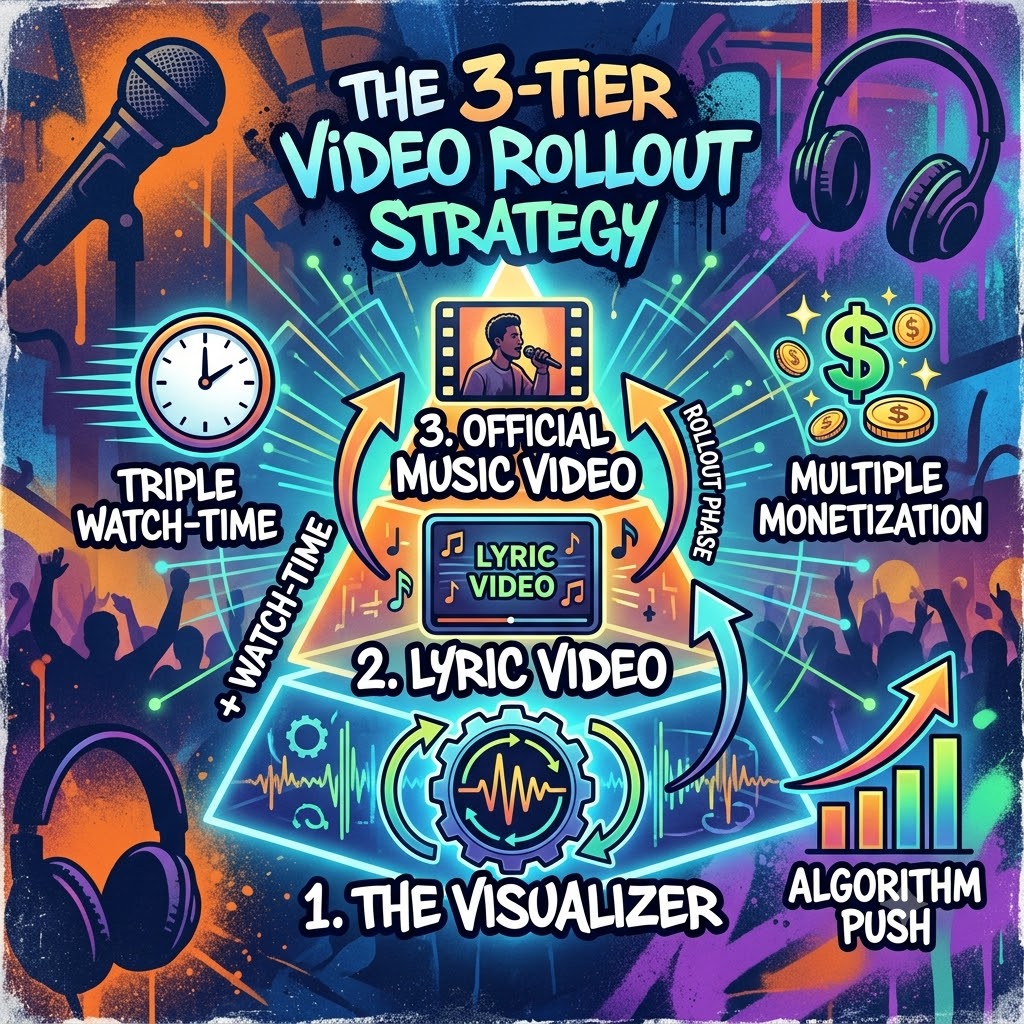
The 3-Tier Music Video Rollout: How to Triple Your Watch-Time and Stack Monetization Cycles
If you’re still dropping a high-budget music video on the exact same day your single hits Spotify and just praying the YouTube algorithm takes pity on you, you’re throwing money down the drain.
The harsh reality of today’s music industry isn’t just that listeners have short attention spans—it’s that platform algorithms actively punish “one-and-done” content strategies. When you pour your entire visual budget into a single video drop, you get a quick burst of attention for 48 hours, followed by a long, agonizing flatline in views.
Smart indie artists, record labels, and digital strategists are ditching the single-drop gamble for a much more calculated play: The 3-Tier Video Rollout Strategy.
By splitting a single release into three distinct visual phases—The Visualizer, The Lyric Video, and The Official Music Video—you transform a routine song release into a six-week content campaign. This approach doesn’t just keep your brand in front of fans longer; it systematically skyrockets your YouTube channel watch-time and opens up multiple windows to monetize the exact same track.
Here is a complete breakdown of how the 3-tier system works, why the math favors it, and how you can implement it on your next drop.
What Is the 3-Tier Video Rollout Strategy?
Instead of treating a music video as a single event, the 3-tier rollout treats visual content as a multi-stage storytelling process. You produce three different visual assets for one single track and stagger their release dates over a four to six-week window.
Each phase speaks to a different layer of your audience, serving a very specific psychological and algorithmic purpose.
Tier 1: The Audio Visualizer (Drop Day)
The Goal: Fast execution, day-one engagement, and immediate algorithmic indexing.
When your song goes live on streaming platforms, fans who prefer listening on YouTube need somewhere to go immediately. But building a full-scale music video in time for single release day isn’t always realistic or cost-effective.
Enter the audio visualizer. This isn’t a complex cinematic piece; it’s usually a seamlessly looping 3D animation, a dynamic piece of cover art motion graphic, or stylized visual mood footage.
-
Why it works: It requires minimal budget and quick turnaround time. More importantly, it captures the initial wave of release-day hype without blowing the big visual reveal. It anchors your master audio on YouTube on day one, so you start collecting streaming data, search impressions, and ad revenue right out of the gate.
Tier 2: The Lyric Video (Weeks 2–3)
The Goal: Audience retention, deep song familiarity, and active user engagement.
About ten days after your single drops, the initial release hype naturally starts to cool off. This is precisely when most artists panic and move on to the next song. Instead, you drop Tier 2: The Lyric Video.
By this point, casual listeners have heard the song a few times, but your dedicated fans are actively trying to learn the words. A well-designed, stylized lyric video gives them a reason to come back and watch the song from start to finish.
-
Why it works: Lyric videos carry some of the highest audience retention rates on YouTube. Viewers rarely click away early because they are reading along in real-time. This high retention sends a massive positive signal to YouTube’s recommendation engine. Additionally, lyrics generate high search volume on both YouTube and Google, capturing organic traffic from people searching for specific lines or hooks.
Tier 3: The Official Music Video (Weeks 4–6)
The Goal: The ultimate cultural payoff, press leverage, and peak channel authority.
By the time you roll out the official music video, your fan base already knows every single word to the track. They’ve spent weeks streaming the audio visualizer and singing along to the lyric video. Expectations are built up, and the audience is primed for a grand visual payoff.
The official video acts as your cinematic capstone. It’s the narrative, high-production centerpiece designed to make a real statement about your aesthetic and artistic identity.
-
Why it works: Because your channel has been consistently accumulating views, comments, and high watch-time over the preceding month, YouTube’s algorithm views your channel as “hot.” When you drop the main video into a channel with active momentum, the algorithm is far more likely to push it to recommended feeds, homepages, and related video sidebars.
The Algorithmic Math: How This Triples Your Channel Watch-Time
YouTube’s core recommendation architecture isn’t complex at its core: it rewards channels that keep users on the platform longer. The two metrics that dictate whether your content gets pushed or buried are Click-Through Rate (CTR) and Average Duration Viewed (Watch-Time).
Here is why a single video drop struggles, while a 3-tier rollout thrives:
1. The Single-Drop Trap
When you post only one music video, a fan clicks it once, watches 3 minutes, and leaves. You get 3 minutes of watch-time out of that user for the entire life of the single. If they don’t like the thumbnail or don’t have time for a full video that day, you get zero.
2. The Compounding Multiplier Effect
With a 3-tier strategy, you create three separate entry points for the same audience member:
-
Drop 1: Fan watches the Visualizer (2.5 minutes of watch-time).
-
Drop 2: Fan returns two weeks later for the Lyric Video (3 minutes of watch-time).
-
Drop 3: Fan tunes in for the premiere of the Official Video (3.5 minutes of watch-time).
That single viewer just gave your channel 9 minutes of cumulative watch-time instead of 3. Multiply that across thousands of casual listeners, and your total channel watch-time literally triples.
This sustained surge of activity signals to YouTube that your channel is consistently generating fresh engagement, leading to broader organic distribution across all your uploads.
Unlocking Multiple Monetization Cycles
Beyond boosting metrics, a staggered rollout completely changes the financial economics of releasing music. Instead of relying on a single moment to generate revenue, you build three distinct monetization cycles into a single release cycle:
| Campaign Phase | Content Focus | Primary Revenue & Growth Drivers |
| Cycle 1 (Weeks 1–2) | Visualizer | Fast streaming ad revenue, digital store links, early social media conversions. |
| Cycle 2 (Weeks 3–4) | Lyric Video | High-retention YouTube ad revenue, user-generated content (Reels/TikTok clips), lyric search traffic. |
| Cycle 3 (Weeks 5–6+) | Official Video | Premium ad revenue, sync licensing pitches, merch integration, blog/press coverage, and long-term brand equity. |
Instead of burning through your marketing budget in 48 hours, every dollar you spend builds on the momentum of the previous release, giving your music a much longer shelf-life and a higher return on investment.
Executing Your Next Rollout Strategy
If you want to build a sustainable career as an independent artist or digital creator, consistency and strategic distribution matter just as much as the music itself. Stop letting your visual assets sit in a single file folder waiting for a one-time upload. Structure your releases, give your fans multiple reasons to engage, and treat every track like a full-scale digital campaign.
To maximize channel watch-time across every drop by utilizing our music video marketing plans, team up with specialists who understand how to drive real visual velocity in today’s crowded market.