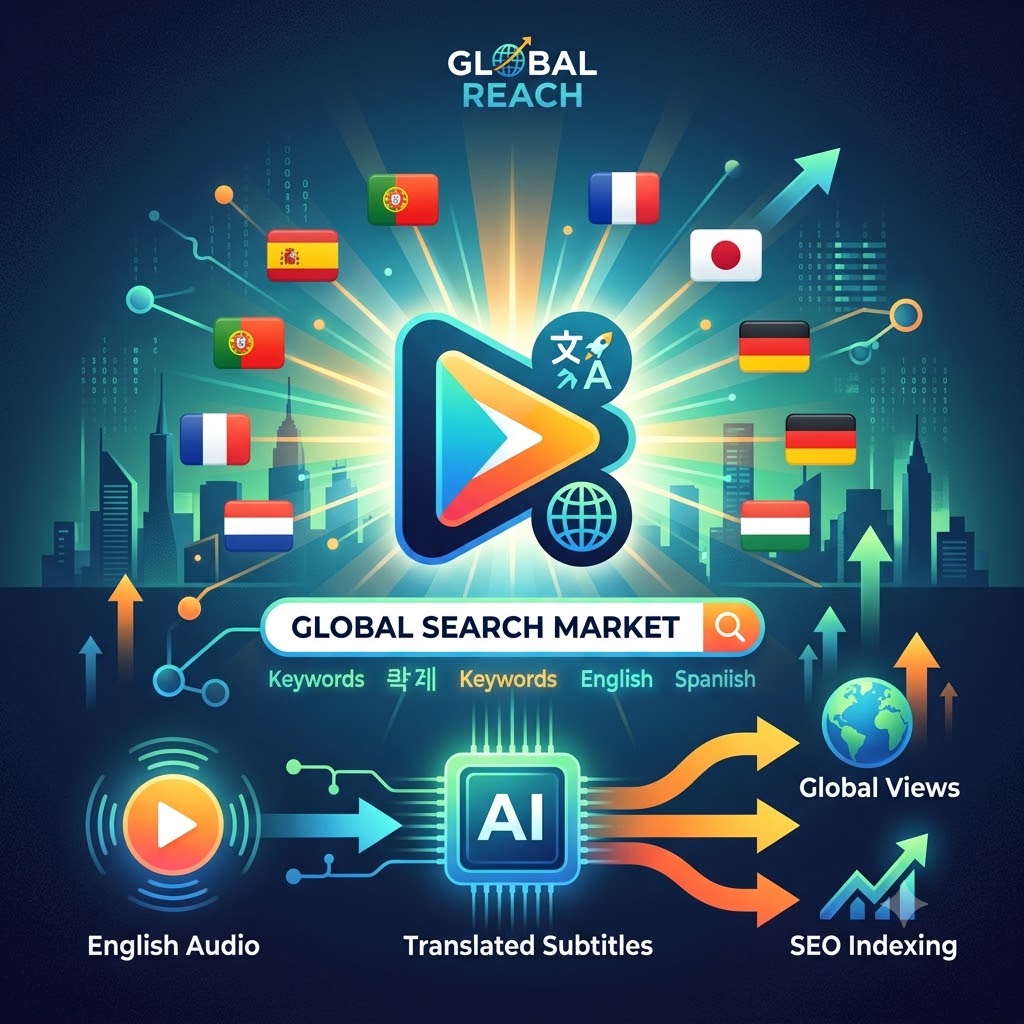
How AI Auto-Captions Unlock Massive Non-English Views on YouTube
If you’re only creating content in English and leaving it at that, you’re missing out on more than half of YouTube’s global audience.
Think about how YouTube actually works behind the scenes. Millions of hours of content are uploaded every single day, and the platform’s algorithm needs a clear way to parse what your video is about so it can show it to the right viewers. It scans your title, your description, and most importantly, your transcript.
If your video only has an English audio track and standard English auto-captions, YouTube’s search crawlers will only index it for English search queries. But what happens when someone in Mexico City, Tokyo, Paris, or São Paulo searches for content just like yours in their native language?
Your video simply won’t show up.
By leveraging AI auto-captions alongside AI-powered translation tools, you can break through regional search barriers, translate subtitle files into dozens of languages, and get YouTube’s algorithms to index your videos across dozens of non-English search markets simultaneously.
Here is how you can use this simple SEO workflow to expand your global footprint and drive massive international views.
Why YouTube’s Search Engine Loves Multi-Language Subtitles
YouTube isn’t just a video platform—it’s the second-largest search engine on the planet, right behind Google. Just like traditional web Google bots crawl text on web pages, YouTube’s bots crawl text inside video files to figure out relevance.
When you upload dedicated, time-coded subtitle files (such as .srt or .vtt files) in multiple languages, YouTube doesn’t just display those captions to viewers—it parses every single word into its search index for that specific language market.
Here is why this strategy creates an immediate edge for your channel’s SEO:
1. Instant Keyword Expansion Across Global Search Markets
If you release an English-language video about hip-hop beat production or urban culture, you are competing against millions of other English videos for saturated terms.
However, if you translate your closed captions into Spanish (producción de beats de hip hop), Portuguese (produção de beats de rap), or French (création de beat hip-hop), YouTube’s indexer registers your video for those exact search queries in those specific countries. You suddenly tap into low-competition, high-demand search markets without having to re-shoot or re-dub a single frame of your original video.
2. Boosted CTR (Click-Through Rate) with Localized Titles and Descriptions
SEO doesn’t stop at indexing—you still need the user to actually click on your video. YouTube allows creators to set up multi-language metadata alongside translated subtitles.
When a user in Brazil searches in Portuguese and sees your video pop up with a title and description translated into Portuguese, their likelihood of clicking skyrockets. A high click-through rate tells YouTube’s algorithm that your video is highly relevant, prompting the system to recommend it even further across regional home feeds and suggested video sidebars.
3. Extended Watch Time and Stronger Engagement Signals
Watch time remains one of YouTube’s most critical ranking factors. Non-native speakers often struggle to keep up with fast-paced English speech, specialized jargon, or heavy accents.
When you provide clear, accurate subtitles in their primary language, viewers stay tuned in far longer. Additionally, a massive percentage of mobile users watch videos on mute while commuting or in public spaces. Captions keep those viewers engaged instead of scrolling past, directly boosting your average view duration (AVD) and signaling to the algorithm that your content deserves top placement.
A Step-by-Step AI Subtitle Workflow for Maximum Indexing
Manually translating a 10-minute video into 10 different languages used to cost hundreds of dollars and take days of work through professional translation agencies. Today, modern AI speech-to-text and neural translation engines let you execute this entire process in minutes.
Here is a simple, repeatable workflow you can use for every video you publish:
Step 1: Generate a Clean Source Transcript
Never rely solely on YouTube’s default auto-generated English captions for translation. YouTube’s built-in speech recognition often misses brand names, slang, and technical terminology. If your source text has errors, every single translated language file will end up distorted.
Run your raw video audio through an AI transcription platform (such as Whisper-based tools or specialized transcription software). Review the text once to ensure names, localized slang, and punctuation are completely clean.
Step 2: Run Translations Through Context-Aware AI
Once you have an accurate master transcript, feed the .srt or text file into an advanced AI translation tool. Specialized language models excel at catching context, colloquialisms, and cultural nuance much better than standard literal translators.
Focus on targeting high-growth YouTube regions first. Excellent starting languages for maximum reach include:
-
Spanish (opens up Spain and Latin America)
-
Portuguese (opens up Brazil and Portugal)
-
French (opens up France, parts of Canada, and West Africa)
-
German (opens up Central Europe)
-
Japanese & Korean (opens up highly engaged Asian markets)
Step 3: Upload Translated .srt Files to YouTube Studio
Head into your YouTube Studio dashboard, navigate to the Subtitles section of your video, and click Add Language.
For each target market, upload your newly generated time-coded subtitle file. Don’t forget to also fill in the translated Title and Description fields for each language added. This ensures YouTube’s crawler has full metadata context to index your video properly in every regional market you choose.
Beyond SEO: Scaling Your International Footprint
Optimizing your subtitles for international indexers is one of the most effective organic growth levers available today, but combining technical video SEO with targeted promotion creates a powerful compounding effect.
When your channel starts receiving traffic signals from international search queries, boosting those initial numbers helps trigger YouTube’s recommendation engine faster. If you want to accelerate your growth and expand your international view metrics using our specialized urban video promotion services, strategic outreach can give your localized content the initial push it needs to dominate competitive rankings.
Final Thoughts
The internet is global, but far too many creators treat their YouTube channels like local broadcasts. By using AI auto-captions and structured translation workflows, you transform every single video you upload into an international asset that YouTube’s crawlers can understand, index, and promote across the globe.
Start by optimizing your top-performing existing videos with multi-language captions today, monitor your analytics for international traffic spikes, and watch your channel’s global footprint expand.
Ready to Scale Your Video Reach Globally?
Take your channel’s distribution to the next level and get your content in front of active audiences worldwide.
Submit your link on our official Music Video Submission Page today to start growing your international exposure!