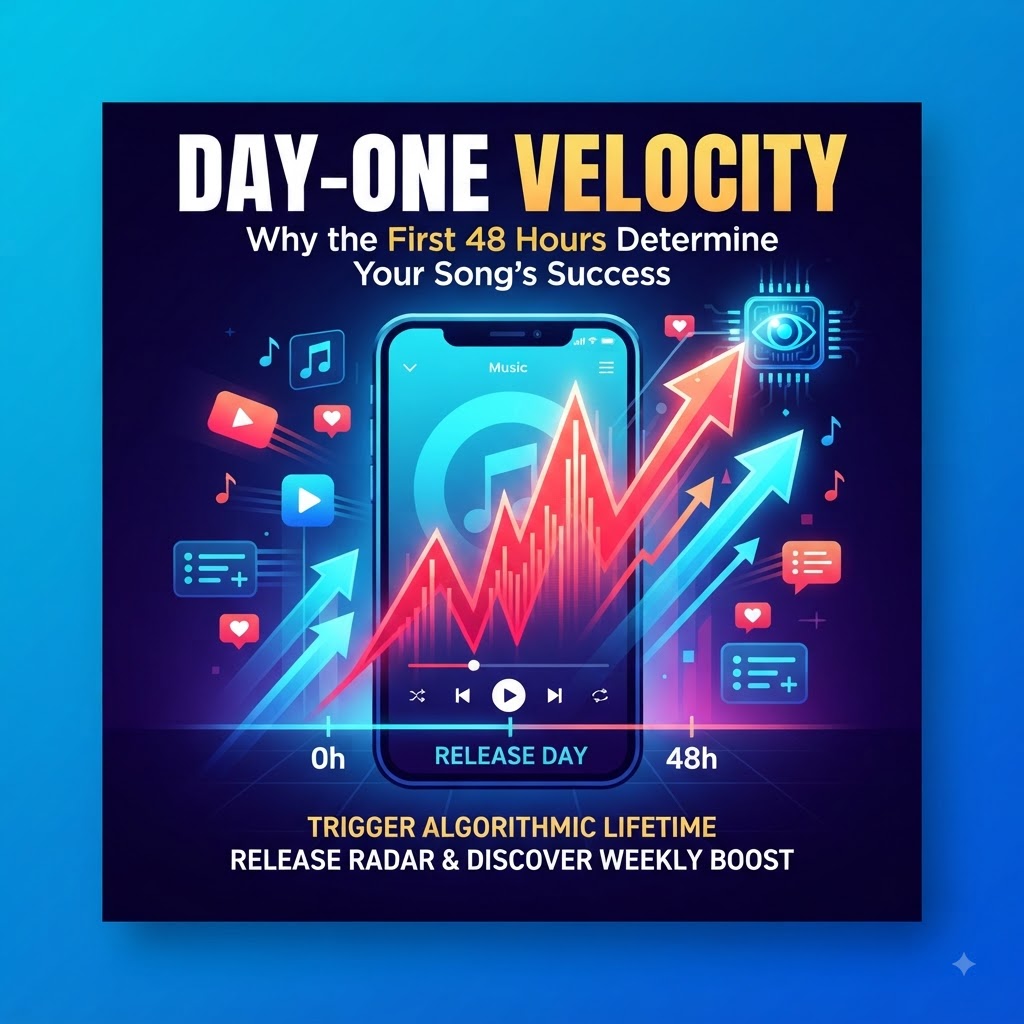
Day-One Velocity: Why the First 48 Hours Determine Your Song’s Algorithmic Lifetime
We’ve all been there: you spend months writing, recording, mixing, and mastering a track. You line up the distribution, drop it at midnight, and then… crickets.
Meanwhile, you see other artists drop a track and watch it instantly catch fire across Spotify and Apple Music.
What’s the secret? It’s not just luck or a massive budget. More often than not, it comes down to Day-One Velocity—and it’s the single most important metric for independent artists today.
What Actually Happens on Release Day?
Here’s the reality of how streaming algorithms work behind the scenes. Platforms like Spotify don’t have a team of curators sitting around manually listening to every single song uploaded every week (tens of thousands of them). They rely entirely on math and data.
When your track goes live, the algorithm treats it like an experiment. It drops your song in front of a small test audience—usually your core followers or people who follow similar artists.
Then, it watches the clock. It wants to know:
-
Did people actually listen to the whole thing, or did they skip after 10 seconds?
-
Are they saving it to their library?
-
Are they adding it to personal playlists?
If those early listeners engage immediately, the algorithm registers a spike in momentum. It says, “Okay, people actually like this,” and opens the floodgates to a wider audience. If they don’t, the track quietly gets pushed to the back burner.
The Release Radar Choke Point
Let’s talk about the holy grail of streaming: Release Radar.
Getting onto Release Radar is what turns a one-week hobby release into a six-month growth engine. But the algorithm only feeds tracks into Release Radar if they’ve proven they can hold an audience’s attention right out of the gate.
-
A slow rollout kills momentum: If your streams trickle in slowly over two weeks, the algorithm assumes the track is stale before it ever gets a chance.
-
A concentrated spike unlocks reach: If you can concentrate your core audience’s listening habits into a tight 48-hour window, you send a flare gun up to the platform’s recommendation engine.
Essentially, those first two days are your only chance to prove to a robot that your music deserves to be heard.
Moving Past the “Hope and Pray” Strategy
You can’t just drop a link on your Instagram story on Friday morning and hope for the best anymore. The competition is too fierce, and the algorithm is too fast.
To win at streaming, you need a coordinated campaign. You have to prime your audience weeks in advance, align your short-form video content, and maximize your drop-day streaming metrics by coordinating your launch with our team.
When you orchestrate a rollout where your fans show up all at once, you stop fighting the algorithm and start making it work for you.
Stop letting your best music slip through the cracks.
Deliver maximum release velocity to your drop. Apply through our ArtistRack team today to get your next release the strategic push it deserves.