If you’re an underground rapper spending eight months locking yourself in a cave to craft a flawless 12-track project or a dense 6-song EP, hear me out.
You’re playing a 2015 game in a 2026 streaming world.
For major label acts with millions of monthly listeners, a massive, hyped-up album rollout makes total sense. They’ve got the marketing budget, playlist backing, and media muscle to sustain it. But if you’re an independent artist trying to build a real fanbase from the ground up, dropping a project once a year and then ghosting is practically a guarantee that the algorithm will forget you exist.
Let’s talk about the actual math behind release frequency, and why dropping singles every 3 to 4 weeks completely smokes the traditional “drop and pray” strategy.
The Math Problem: 1 Big Drop vs. 12 Algorithmic Touchpoints
To understand why consistency always wins, you have to look at how platforms like Spotify, Apple Music, and YouTube Music actually work under the hood.
-
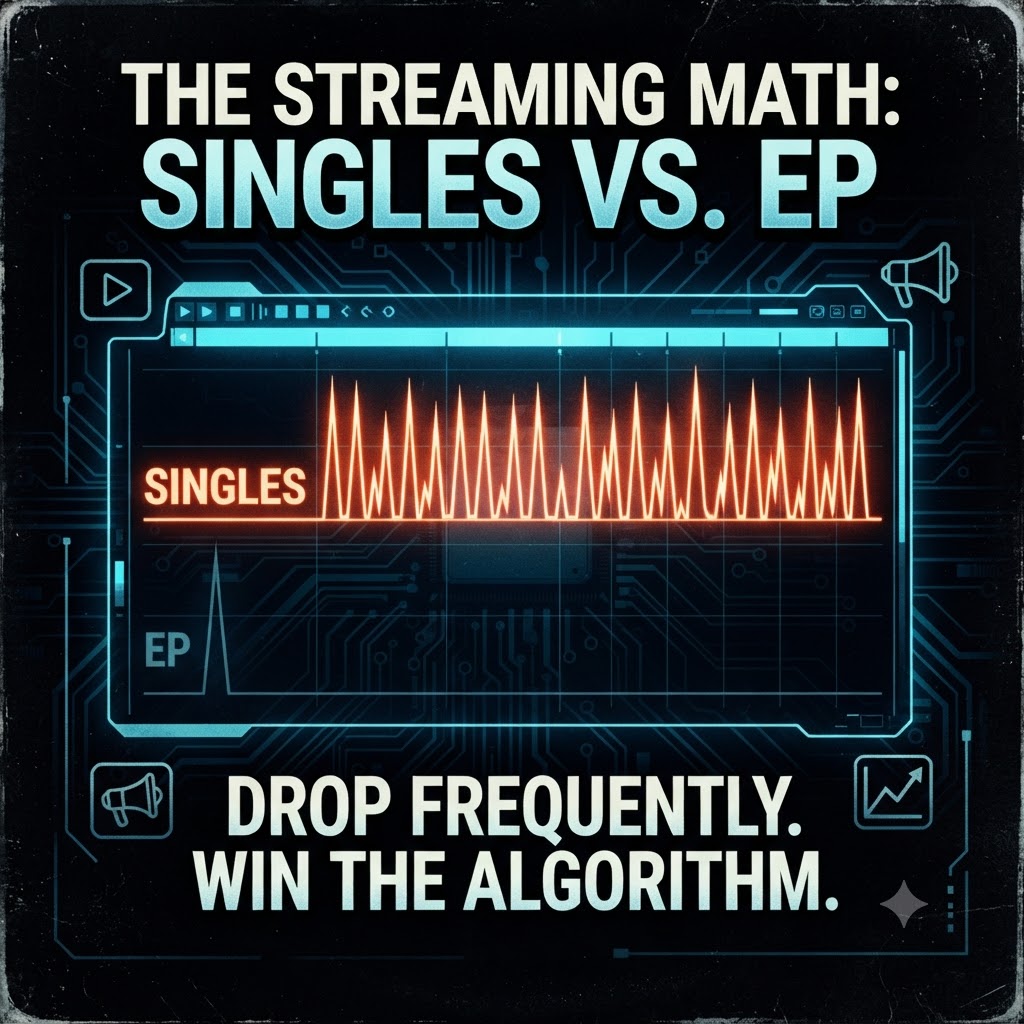
The EP/Album Model (Once a Year): You spend months recording, polish up a 6-song EP, and drop it all on a single Friday. For about two weeks, you get a quick wave of traffic. Your core fans listen, Release Radar triggers once, and then—crickets. For the remaining 50 weeks of the year, your streaming profile is flatlining. The algorithm stops learning who likes your music, stops testing you out on new listeners, and moves on to someone else.
-
The Single Model (Every 3–4 Weeks): Let’s say you batch your tracks and commit to dropping a single a month (roughly 12 tracks a year). That means 12 separate Release Radar hits, 12 distinct TikTok content cycles, 12 chances to pitch for editorial playlists, and 12 different opportunities for the algorithm to test your sound on new audiences.
Every time a new track drops, you feed the platform fresh data. Are people saving it? Are they adding it to personal playlists? Are they skipping it instantly? The algorithm is hungry for fresh metrics. By feeding it regularly, you stay relevant.
Why Underground Rappers Specifically Need the 3–4 Week Cycle
1. Short Attention Spans and Playlist Culture
Hip-hop moves at lightning speed. Playlists—both algorithmic and user-made—drive the culture. Curators rarely dig deep into a random track on an underground EP unless that specific song has already proven it can pull weight on its own. Dropping singles gives you a direct weapon to pitch curators over and over, rather than asking a stranger to digest a 15-minute body of work from an artist they’ve never heard of.
2. Avoiding Content Fatigue
Trying to market one single project for six straight months is exhausting for both you and your audience. Your snippets get old, your visual concepts get stretched too thin, and eventually, you run out of things to say.
Instead, a 3–4 week cycle forces you into a tight, aggressive “micro-rollout”:
-
Week 1: Tease it on TikTok/Reels and set up your pre-saves.
-
Week 2: Drop day + performance or lyric video.
-
Week 3: Push user-generated content, maybe drop a remix or a quick breakdown.
-
Week 4: Start teasing the next track.
It keeps your workflow fast, stops you from overthinking every single move, and keeps your social feeds naturally active with music.
3. The “Waterfall” Cheat Code
Here’s the best part: you don’t actually have to abandon EPs forever. You can use a waterfall release strategy. You drop 3 or 4 singles sequentially every few weeks, and then bundle them all together into an EP package.
By the time the actual EP goes live, every single track on it has already built up its own streaming history, algorithmic weight, and fan loyalty. You get the best of both worlds: constant momentum upfront and a cohesive project at the end.
Keeping the Momentum Alive
If you want to build a sustainable career in underground hip-hop, you can’t afford to vanish for months at a time. You need to keep your streaming profile warm all year by backing every single drop with our distribution and pitching tools.