


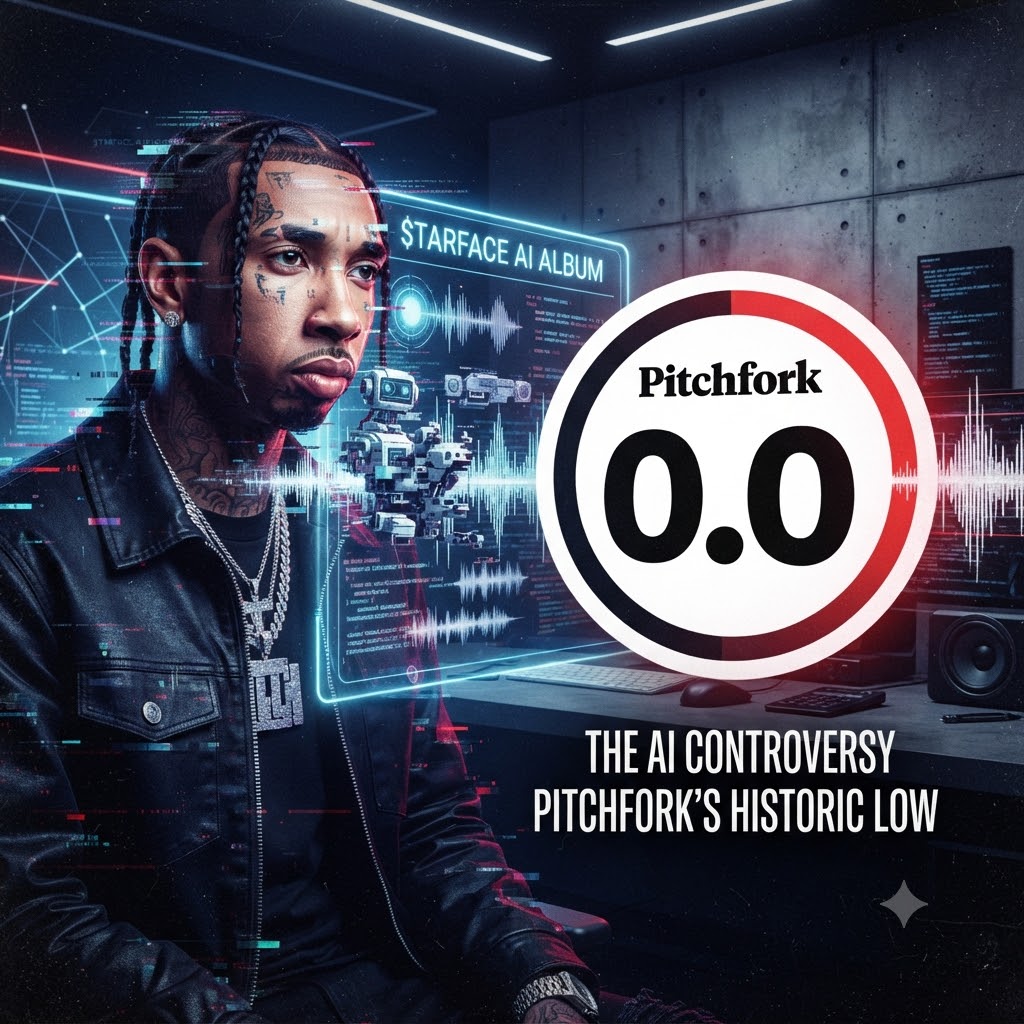
Tyga’s AI Album Controversy and the Pitchfork 0.0: A Turning Point for Hip-Hop
The collision between artificial intelligence and the music industry has officially moved past theoretical debates and straight into full-blown crisis mode. For the last couple of years, producers, artists, and fans have argued back and forth over the ethics of synthetic vocals and platforms like Suno AI. But the conversation reached a boiling point when Tyga leaned all the way into the tech, confirming his use of AI generation for his project, $TARFACE.
The backlash was instant and unforgiving—culminating in Pitchfork handing down a 0.0 rating, their first zero-score in nearly 20 years.
Whether this is viewed as a reckless stunt or a grim glimpse into the future, one thing is clear: the rulebook for hip-hop rollouts just got ripped apart.
Inside the $TARFACE Controversy
When $TARFACE dropped, listeners immediately noticed something felt off. The cadence, the vocal tones, and the production had that unmistakable, slightly hollow “uncanny valley” texture. Almost instantly, internet sleuths and critics started pointing fingers, suspecting heavy reliance on generative AI tools like Suno.
Instead of dodging the rumors, Tyga confirmed that AI played a massive role in the project. That admission hit a nerve. Hip-hop is a genre built on raw lived experience, personal storytelling, and the sweat of the grind. Handing the creative keys over to an algorithm felt to many fans like a betrayal of the culture’s core foundation.
The real cultural earthquake, though, was the Pitchfork review. Reviews that low are exceptionally rare, and giving $TARFACE a 0.0—a score the publication hadn’t dealt out in almost two decades—was a massive statement. It wasn’t just a critique of how the music sounded; it was a loud warning shot to the rest of the industry about where things are headed if artists stop putting actual human soul into their work.
Where Do We Draw the Line Between Innovation and Laziness?
To be fair, hip-hop has always thrived on technology. Sampling, the Roland TR-808, MIDI, Auto-Tune, and modern plugins completely changed the game. Innovation isn’t the enemy.
The problem with generative AI is what it replaces.
-
The Tech Side: Some creators argue that AI is just another tool to spark ideas, test out wild production textures, or push past writer’s block.
-
The Human Side: Hip-hop’s currency is authenticity. When the lyrics or the core identity of a song are outsourced to a server farm, the human connection evaporates. The Pitchfork backlash proved that fans and critics aren’t going to just accept manufactured art without a fight. They want to connect with a real person behind the mic.
Protecting Real Artistry in the Age of AI
The whole $TARFACE mess is a huge wake-up call for independent artists and major acts alike. If you’re experimenting with modern tech in your workflow, you have to be smart about how you present it.
People are willing to embrace new sounds, but they will never compromise on genuine emotion. The technology should assist your vision, not be your vision.
Keep the Culture Real: Submit Your Music
Don’t let algorithms speak for your craft. If you’re an artist navigating this wild new landscape, lean into what makes your perspective unique. Address AI tools in your rollout, but guarantee human presentation by submitting your tracks to our music submission portal (https://itshiphopmusic.com/submit/music-submission/).
Let’s keep hip-hop grounded in real human stories. Send us your work and show the culture what authentic artistry looks like today.













 and Pitchfork's historic 0.0 rating, exploring the impact of generative AI on hip-hop authenticity.)