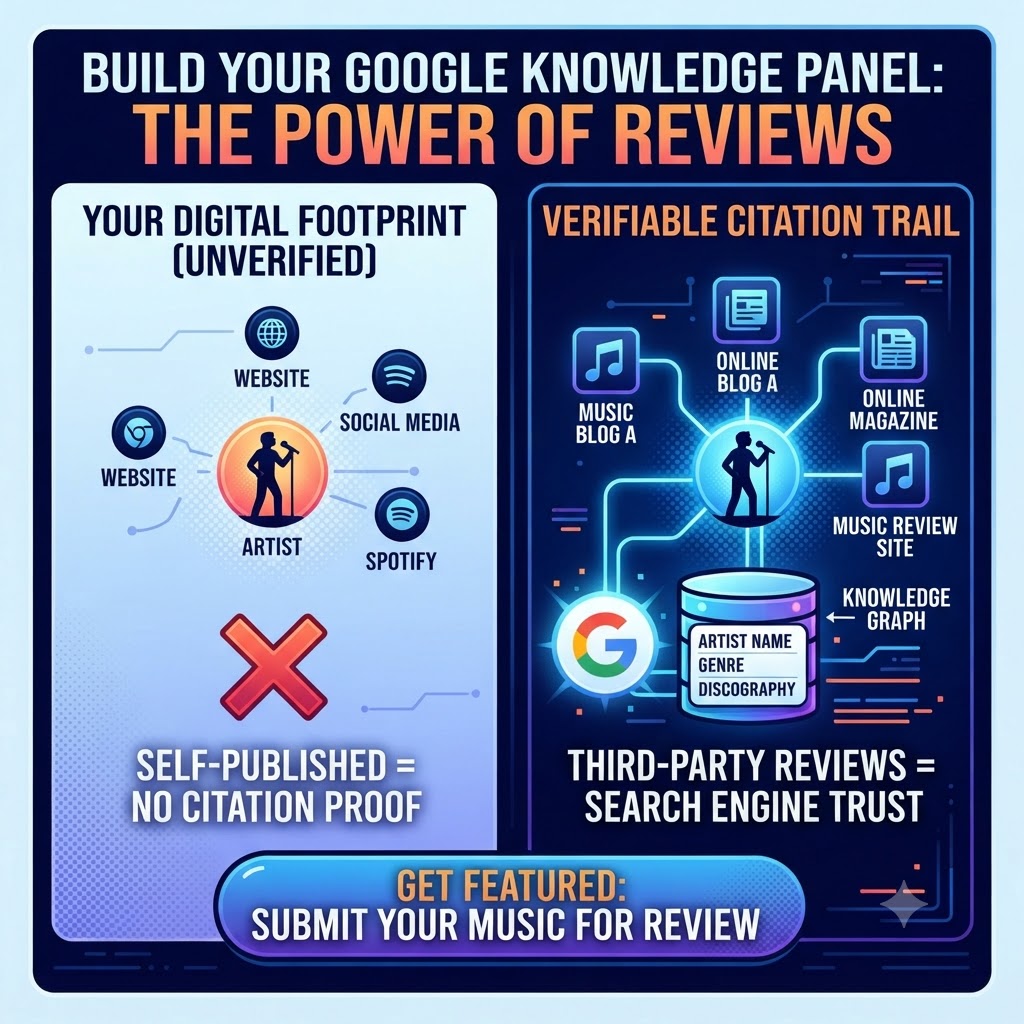
Securing a Google Knowledge Panel is the ultimate milestone for any artist. It proves to the world—and to the algorithm—that you are an established, verifiable entity in the music industry. But getting that coveted panel on the right side of the search results isn’t about stuffing keywords into your Instagram bio. It comes down to citation proof.
Google’s Knowledge Graph doesn’t just take your word for who you are. It needs receipts.
Why Google Needs Third-Party Citations
Think of the Knowledge Graph as a massive web of connected facts. When Google crawls the web to figure out whether an artist is “notable” enough for a panel, it looks for external validation.
If your bio only lives on your own website, Linktree, and Spotify page, you’re missing the crucial ingredient: third-party trust signals. Search engines rely on established music blogs, digital magazines, and independent review sites to corroborate your existence. If reputable writers aren’t talking about you, the algorithm struggles to connect the dots.
How Music Reviews Act as Anchor Proof
When an independent publication reviews your single, album, or EP, they aren’t just helping you catch new ears—they are creating the verifiable digital source trail required for search indexing with an official online music review.
Here is what happens behind the scenes when a review goes live:
-
Entity Mapping: Search engine crawlers parse the review, linking your artist name, genre, hometown, and release titles together in a trusted editorial context.
-
Domain Authority Transfer: When a reputable music site references your work, a bit of that domain’s trust rubs off on your digital footprint, signaling to Google that you are a real-world entity worth indexing.
-
Clearing the Ambiguity Threshold: If you share a name with an athlete, an author, or a vintage jazz player, third-party music reviews give Google the exact context it needs to separate your artist profile from the noise.
Escaping the Vanity Metric Trap
Too many indie artists waste time chasing follower counts, assuming that a massive TikTok following automatically triggers a Knowledge Panel. While audience engagement is great for your career, search algorithms prioritize editorial footprint over vanity metrics.
Social media posts are fast-moving and easily manipulated. In contrast, a well-written, archived review is permanent, structured, and heavily weighted by search crawlers looking for proof of cultural impact.
Building Your Entity Footprint
If you’re trying to push your career to the next level and get your digital house in order for search engines, stop relying solely on self-published content. Invest in getting your music actually written about by people who know the culture. Real editorial coverage builds the exact paper trail algorithms look for when granting official entity status.
Build your verifiable media source history. Ready to get your next release in front of an editorial team and feed the search engines the trusted citations they need? Submit your tracks directly to our team via the Music Review Submission Portal.