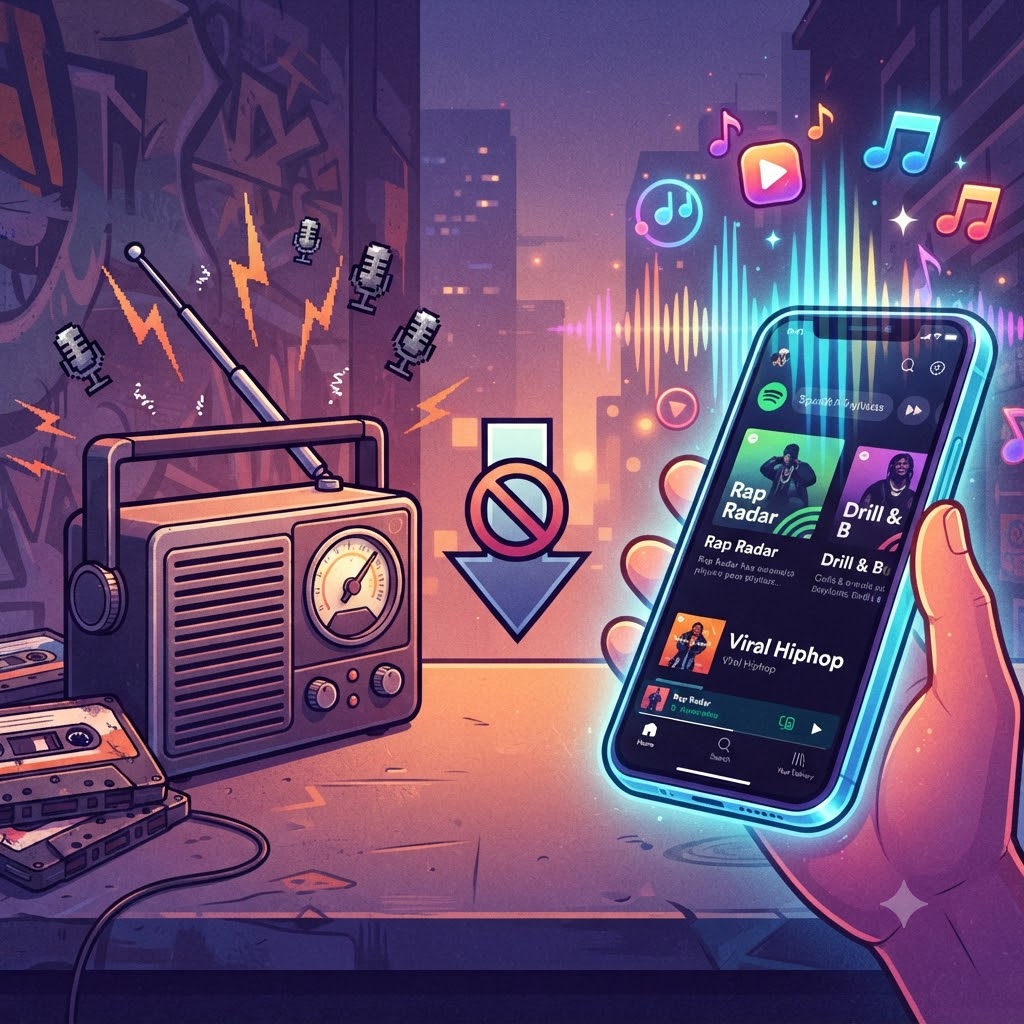
Remember when finding the next big hip-hop track meant sitting in your car, staring at the radio, waiting for the DJ to finally name-drop the song that just played? Or rushing to record a countdown on a cassette tape?
Those days are officially gone.
If you talk to anyone under 25 about terrestrial FM radio, you’ll likely get a blank stare. Gen Z and Gen Alpha aren’t just tuning out—they’re bypassing traditional hip-hop radio stations entirely. Instead, they live inside user-generated streaming playlists, algorithmic drops, and hyper-niche digital communities.
So, what happened to the once-mighty reign of FM rap radio? And more importantly, how is this shifting the entire landscape of how we discover music? Let’s break it down.
The End of the Corporate Gatekeeper Era
For decades, terrestrial radio stations held all the cards. Program directors and corporate executives decided which tracks got heavy rotation, creating a massive bottleneck. If you didn’t have a major-label budget pushing your single to radio PDs, getting heard was an uphill battle.
Younger listeners have zero patience for that kind of top-down curation.
-
Zero friction, total control: If a listener wants to hear a specific underground drill track or an unreleased SoundCloud snippet right this second, they pull it up on-demand. FM radio simply cannot compete with that level of instant gratification.
-
Micro-genres over mainstream monoliths: Hip-hop isn’t a monolith anymore. We’re deep into an era of hyper-specific subgenres—phonk, pluggnb, rage beats, and melodic trap. A local radio station trying to please a broad demographic can’t pivot fast enough to capture these vibrant, fast-moving underground movements.
Why User-Generated Playlists Won the Culture War
If community tastemakers and independent curators are the new radio DJs, user-generated playlists are the new station dial.
Platforms like Spotify and Apple Music let everyday fans, underground influencers, and dedicated hip-hop heads build playlists tailored to hyper-specific vibes—think “late night 95 freeway drives” or “sub-bass gym motivation.”
-
The trust factor: Fans trust a playlist curated by someone who genuinely loves the culture over a commercial station bound by ad revenue and FCC rules.
-
Infinite freshness: Traditional radio will loop the same top-40 hits for a month straight until everyone is sick of them. A great user-generated playlist updates weekly, keeping the sonic landscape constantly evolving.
The Death Blow: Ads and Censorship
Let’s be honest: sitting through four minutes of insurance commercials and car dealership ads just to hear a song is painful if you grew up with ad-free or premium streaming.
Beyond the ad fatigue, there’s the issue of censorship. Hip-hop is raw, unfiltered poetry. Hearing a track chopped to pieces with radio edits, bleeps, and abrupt cuts ruins the artistic integrity of the music. Why settle for a sanitized version on FM when the uncensored master is sitting right there in your pocket?
What This Means for Hip-Hop Artists and Marketers
If you’re an independent artist or a modern music marketer, playing the old terrestrial radio game is a waste of time and budget. Breaking a hip-hop track today looks completely different:
-
Targeting tastemakers: Getting your song onto influential, user-generated playlists carries way more weight than a late-night radio spin.
-
The TikTok-to-Playlist pipeline: Viral moments and short-term audio trends act as the new gateway drug, pushing listeners straight to full-length streaming tracks.
-
Building organic communities: Artists who win today are the ones interacting directly with fans on Discord and encouraging them to share their own custom playlists.
Wrapping Up
Is terrestrial radio completely dead? Not quite—commuting older generations still keep it on for traffic updates and nostalgia. But as a cultural force in hip-hop? It’s practically ancient history.
Streaming ecosystems have permanently decentralized music discovery, putting the power directly into the hands of the fans and the curators who live and breathe the culture.