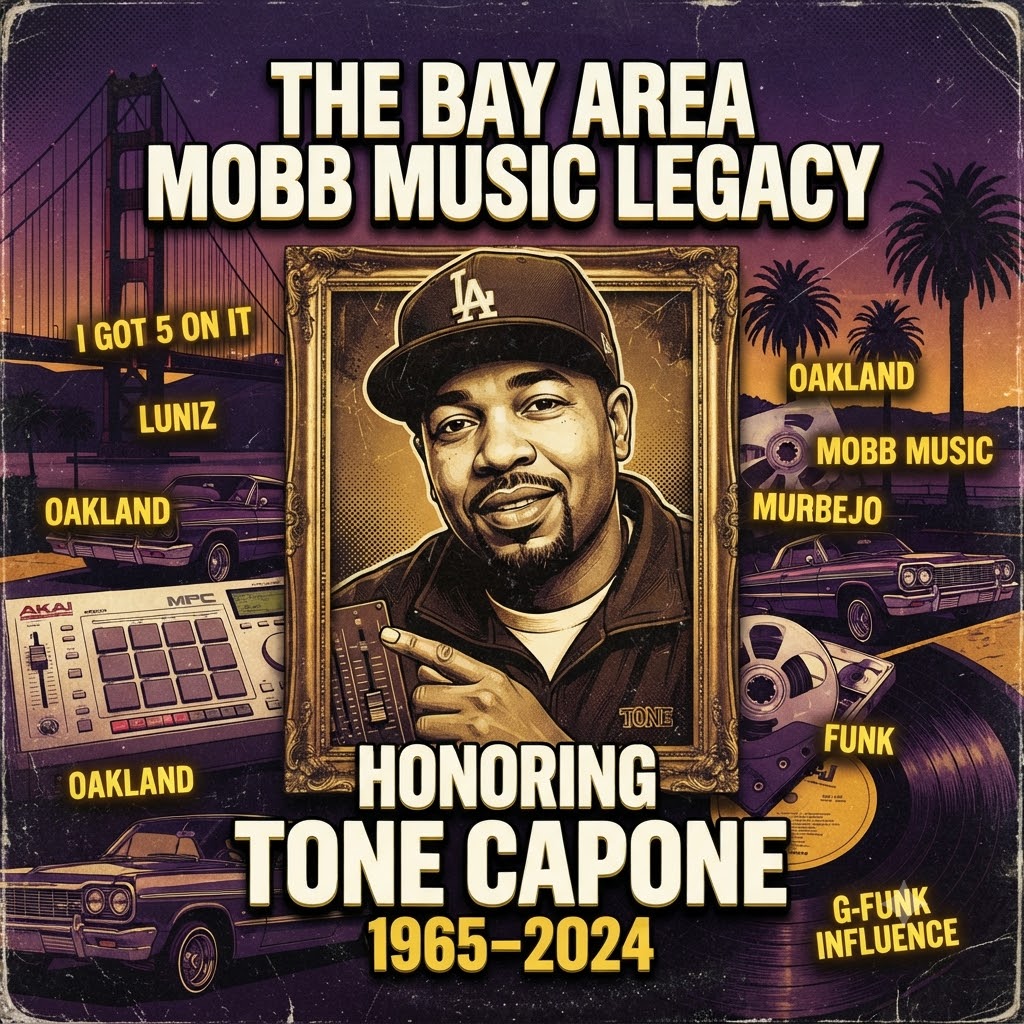
The Bay Area Mobb Music Legacy: Why Tone Capone’s Sound Still Echoes
If you spent any time listening to hip-hop in the mid-to-late ’90s, you know the exact vibe I’m talking about. It’s that heavy, hypnotic bassline, eerie synth, and slick street storytelling that immediately makes you roll your windows down.
Following the passing of legendary producer Anthony “Anthony ‘Tone Capone’ Gilmour” at 59, the hip-hop world has been looking back at his massive footprint. While Los Angeles gets a ton of press for G-Funk, Northern California quietly built its own empire.
Let’s talk about what made Bay Area mobb music so special, the legacy Tone Capone left behind, and why this sound still matters today.
What Exactly Is Bay Area Mobb Music?
Back in the early ’90s, while the rest of the West Coast was leaning hard into high-pitched G-Funk synths, cities like Oakland, Vallejo, and San Francisco were cooking up something darker and funkier.
Mobb music wasn’t just about making club tracks; it was a whole mood. It pulled heavily from P-Funk loops, live instrumentation feels, and the gritty reality of Northern California street life. It was smooth, but it had an edge to it.
Key Elements of the Mobb Sound:
-
The Groove: Deep, rolling basslines that shook the trunk of every Chevy Impala.
-
The Atmosphere: Haunting keys, soulful R&B vocal hooks, and cinematic production.
-
The Pioneers: Producers like Tone Capone and Studio Ton laying down blueprints for icons like E-40, Luniz, and Mac Dre.
The Masterpiece: “I Got 5 On It” and Global Crossover
You simply cannot talk about this era without tipping your hat to “I Got 5 On It” by Luniz. Produced by Tone Capone, the track took a flip of Club Nouveau’s “Why You Treat Me So Bad” and paired it with Michael Marshall’s unforgettable hook.
It wasn’t just a regional hit; it blew up globally, peaking at number 8 on the Billboard Hot 100 in 1995. Even decades later, a whole new generation discovered its chilling brilliance when Jordan Peele used a remix of it in his 2019 horror film, Us.
Tone Capone gave the Bay Area a global anthem, proving you didn’t have to move to LA or New York to change the sound of hip-hop.
Essential Mobb Music Tracks to Add to Your Playlist
If you want to dive deeper into the genre or re-familiarize yourself with Tone Capone’s golden touch, start right here:
-
Luniz – “I Got 5 On It” (1995): The ultimate crossover anthem that put NorCal on the map.
-
3xKrazy – “Keep It on the Real” (1997): Peak street-funk production at its finest.
-
Celly Cel – “It’s Goin’ Down” (1996): A masterclass in high-energy Bay Area bounce.
-
Scarface ft. 2Pac – “Smile” (1997): Proof that Tone Capone’s mobb sensibilities could travel all the way to Houston’s Rap-A-Lot Records and make magic.
Why Mobb Music’s DNA Still Matters Today
Music trends move fast, but great production lasts forever. Long before trap took over the charts, mobb music proved that hip-hop could balance raw street grit with infectious, head-nodding melodies.
Losing architects like Tone Capone hurts, but it also gives us a great reason to dig back through the crates, turn the bass up, and give these legends their flowers while they’re here—and keep their music alive long after.
What’s your go-to Bay Area mobb music track when you’re riding around? Drop your favorites in the comments below!