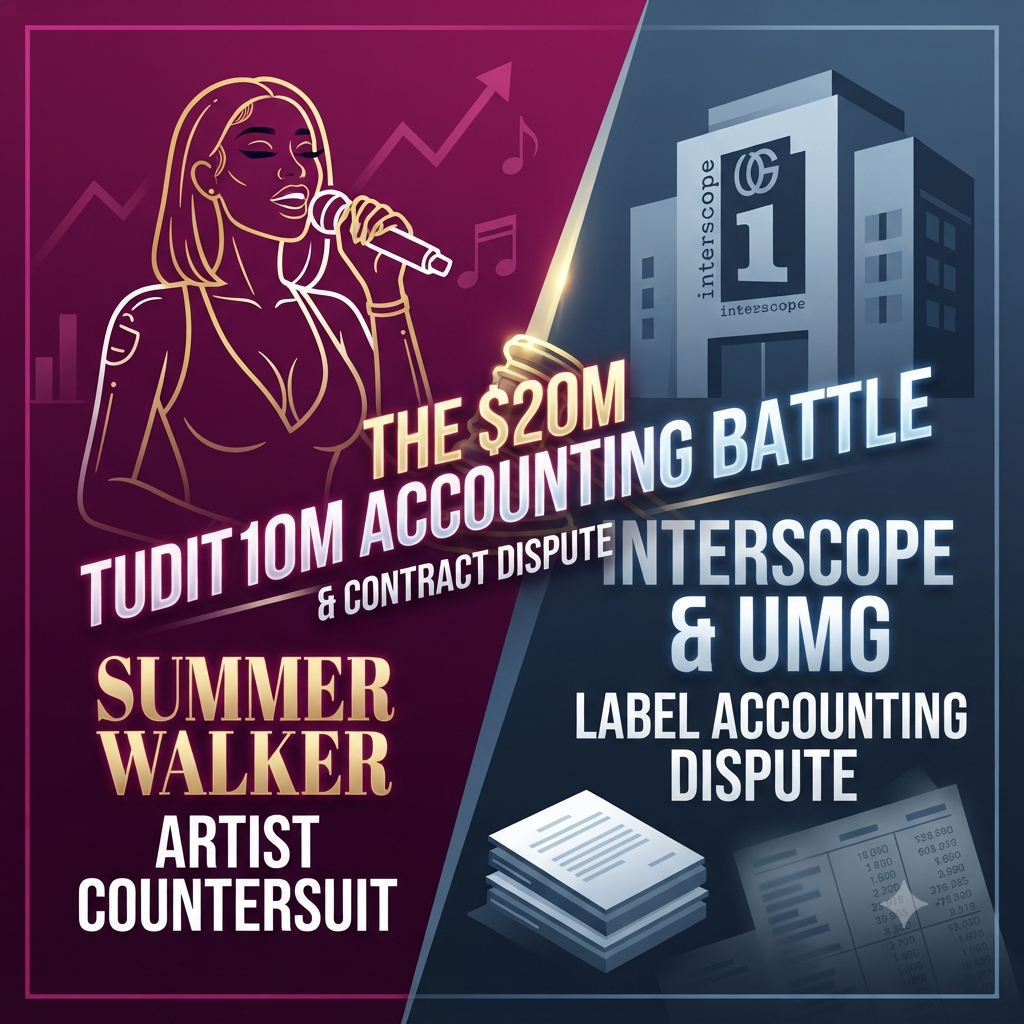
Summer Walker’s $20M Interscope Countersuit: How Major Label Accounting Battles Actually Play Out
When Summer Walker hit Interscope Records and Universal Music Group (UMG) with a $20 million countersuit in November 2026, she did more than escalate an ugly contract breakup. She pulled back the curtain on one of the oldest, messiest arguments in the music business: who actually owns the money once the streams, views, and digital ad checks start clearing.
Just a month earlier, Interscope had sued Walker for $50 million after she invoked California’s seven-year rule to walk away from her 2017 deal. Walker’s response wasn’t just a defensive denial—it was a direct strike at the label’s ledger. Her filing demands damages, a formal court-ordered financial accounting, and the return of profits Interscope allegedly collected from her independently created YouTube content and digital assets.
If you are an independent artist, manager, or label founder, you cannot afford to treat this like celebrity gossip. Watching a record label accounting audit and countersuit unfold at the highest level of R&B shows exactly how major contracts trap revenue—and why building strict audit language into your own agreements is non-negotiable.
What Actually Happened Between Summer Walker, Interscope, and LVRN?
To understand why Walker’s legal team went straight for the accounting books, you have to look at the timeline of her deal.
Back in November 2017, Walker signed with Interscope and Atlanta powerhouse Love Renaissance (LVRN). Fast-forward to August 2026: after nearly nine years under the agreement, Walker’s camp notified Interscope that she was terminating her personal services contract under California Labor Code Section 2855—the famous “seven-year rule” that prevents California employers from locking talent into indefinite contracts.
Interscope didn’t let her walk quietly. The label sued for $50 million, arguing she still owed two full studio albums on a five-album commitment. Their reasoning? Earlier fan-favorite projects like Last Day of Summer and CLEAR were classified on paper as “pre-album projects” rather than official studio albums, meaning they didn’t count toward her delivery minimum.
Walker’s $20 million cross-complaint flipped the script. Alongside a separate legal battle against LVRN accusing the imprint of withholding revenue and misusing recording budgets, Walker’s countersuit against Interscope alleges breach of contract and unjust enrichment. Specifically, her team claims Interscope monetized audiovisual recordings and content tied to her personal YouTube channel without having unrestricted ownership rights to those assets. When a label collects checks on content you own—or refuses to show clear math on where project budgets went—a formal accounting becomes the only weapon left.
The Royalty Accounting Clauses That Catch Artists Off Guard
Most artists obsess over their royalty percentage or the size of their upfront advance. Meanwhile, the clauses that actually decide whether you ever see a backend check are buried twenty pages deeper in the contract.
Recoupment and Cross-Collateralization
Reports around Walker’s original 2017 deal note a modest $110,000 initial advance paired with a 16% royalty rate after recoupment. On paper, paying back $110,000 seems easy once a record goes platinum. In practice, recoupment covers almost everything the label spends: studio time, producer fees, mixing, music videos, tour support, and a healthy chunk of marketing costs.
Even worse is cross-collateralization. When your contract is cross-collateralized, the label treats all your releases and revenue streams as one giant tab. If Album A makes a profit, the label doesn’t wire you a check—they use those profits to pay down the unrecouped debt from Album B, or offset costs from a separate digital video deal.
Digital Content Creep and NIL Overreach
Ten years ago, a label owned your master recordings and your official music videos, and that was mostly it. Today, major agreements include aggressive Name, Image, and Likeness (NIL) and “ancillary rights” language. Without tight legal pushback, those clauses let a label claim YouTube Content ID revenue on your personal vlogs, behind-the-scenes clips, and social media uploads. The label treats your personal channel like a promotional tool while quietly collecting 100% of the ad revenue on the backend.
Summary Statements and Deductions
Before a label calculates your royalty rate, they subtract distribution fees, third-party sub-licensing cuts, and legacy deductions. When your contract doesn’t force the label to provide line-by-line gross data, you end up staring at a vague summary PDF that tells you what they say you earned, with zero visibility into what DSPs and video platforms actually paid them.
How a Record Label Accounting Audit and Countersuit Works
You cannot wake up one morning, decide your royalty check looks light, and drag a distributor or label into court for a random dollar figure. Every record label accounting audit and countersuit follows a strict contractual obstacle course:
-
Serving Formal Notice: You hire a specialized music royalty CPA firm—not a standard tax accountant—and send formal written notice invoking your audit clause.
-
Beating the Incontestability Clock: Almost every label contract includes an “incontestability” clause. It states that if you don’t formally challenge a royalty statement within 12 to 24 months of receiving it, that statement becomes permanently binding. Even if the label shorted you by half a million dollars three years ago, that money is gone forever once the clock runs out.
-
Fighting Scope Limits: Labels rarely hand over the keys to the building. Their contracts usually ban your auditors from inspecting umbrella licensing agreements—the massive, confidential deals major labels cut with Spotify, YouTube, and TikTok for equity, advances, and bulk rate minimums.
-
Using Litigation to Force Discovery: When an audit hits a brick wall—or when a label sues you first, as Interscope did to Walker—filing a countersuit for an accounting moves the fight into court. Judges can compel the kind of financial discovery that standard contract auditors are blocked from seeing.
Why Independent Artists Should Insist on Semi-Annual Audit Windows
If you read the boilerplate language in a standard label, distribution, or label-services deal, you will almost always see an annual audit limit. That means you are allowed to audit the company’s books at most once per calendar year, and you can never audit the same accounting period twice.
For independent artists signing distribution agreements, upstream joint ventures, or funding deals, settling for an annual audit window gives the house way too much room to stall. Pushing for strict semi-annual audit windows—giving you the right to audit every six months—changes the power dynamic immediately:
-
You Catch Digital Leaks Before They Snowball: Streaming payouts, YouTube Content ID claims, and sync splits move in real time. Checking the books every six months catches misrouted ISRCs, improper channel claims, and double-charged marketing expenses early, rather than letting bad math pile up for two years.
-
You Stay Ahead of Incontestability Deadlines: Most labels and distributors issue royalty statements twice a year. Semi-annual audit rights match that exact rhythm, letting your team review and challenge a suspicious statement right after it lands instead of burning months waiting for an annual audit slot to open up.
-
You Create Real Financial Deterrence: A semi-annual audit clause hits twice as hard when you pair it with a cost-shifting provision. This language forces the label or distributor to pay your legal and CPA audit bills if the audit uncovers an underpayment of 5% to 10% or more. Companies get remarkably careful with their accounting when they know you can check their math every six months on their dime.
Your leverage as an artist isn’t just built in the studio—it is built in the fine print before you ever upload a master. Locking down clear ownership over your personal content, refusing vague recoupment buckets, and demanding semi-annual audit windows ensures you never have to sue just to see your own numbers. If you are ready to retain full financial transparency and scale your sovereign career through our artist submission rollouts, make sure your business infrastructure is just as sharp as your catalog.
🚀 Protect Your Independence & Scale Your Brand: Launch a full-scale marketing rollout. Start on our Artist Submission Page.