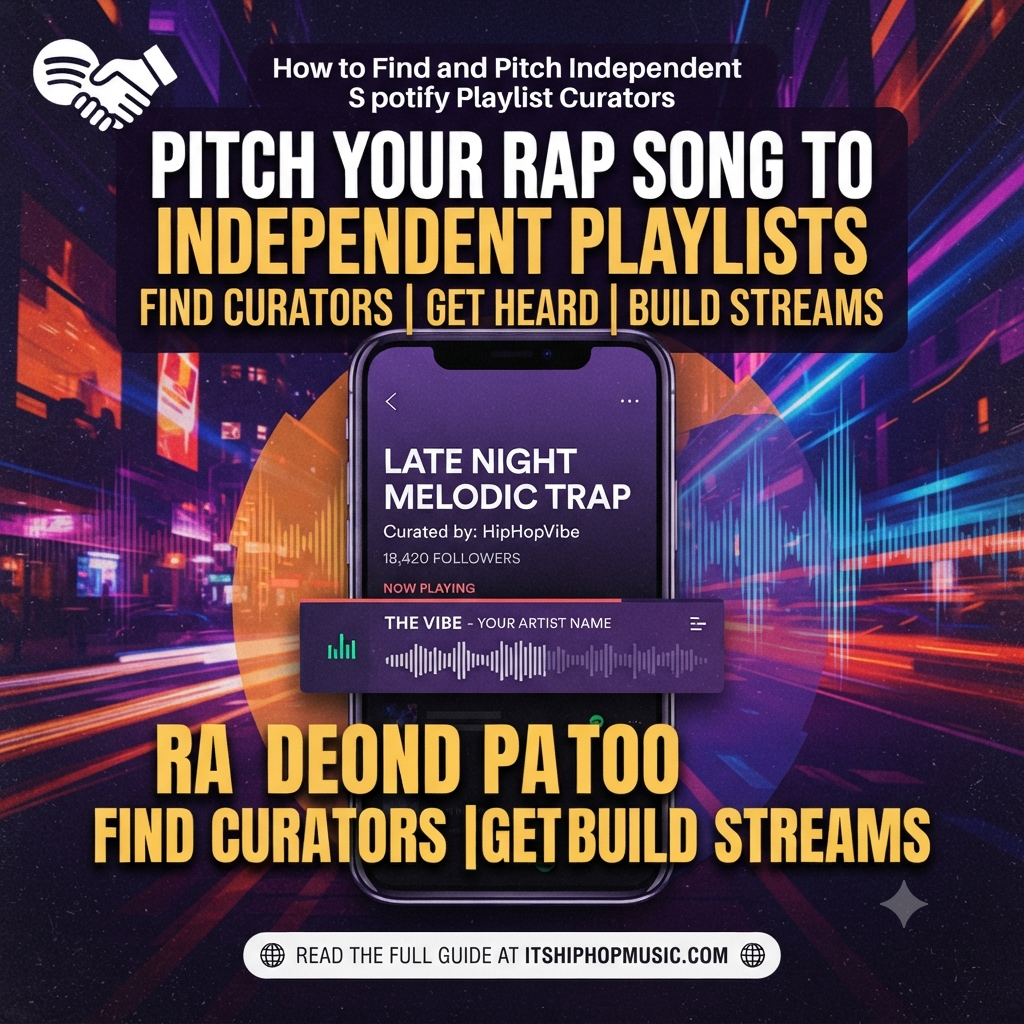
How to Find and Pitch Independent Spotify Playlist Curators for Your Rap Song
If you have ever uploaded a single through your distributor, filled out the Spotify for Artists editorial pitch form, and watched release day come and go with zero editorial love, you are in good company. Tens of thousands of tracks hit Spotify every single day, and the odds of a cold editorial placement on a flagship list like RapCaviar or Most Necessary sit somewhere around one percent.
That is why smart independent rappers stop obsessing over editorial editors and start focusing on the middle class of Spotify: user-curated playlists. Regular music fans, underground hip-hop bloggers, DJs, and crate-diggers run thousands of active playlists that pull in real, attentive listeners every day. Even better, getting added to ten solid user-curated lists gives Spotify’s recommendation engine the listener-retention and save-rate signals it needs to push your song into algorithmic feeds like Discover Weekly and Release Radar.
Learning how to find and pitch independent Spotify playlist curators is not about buying a sketchy email blast or spamming fifty DMs before breakfast. It is a methodical, boots-on-the-ground scouting process. Here is how to track down the right curators for your exact sound, verify that their numbers are real, and send a pitch that actually gets a reply.
Step 1: Dig Deeper Than Generic Genre Keywords
The biggest mistake artists make when prospecting on Spotify is typing “hip-hop” or “rap” into the search bar. Doing that guarantees you will spend an hour scrolling past official Spotify mixes, major-label marketing fronts, and abandoned playlists from 2018 that nobody listens to anymore.
To surface active, independent curators, you have to search the way a real fan searches when they are looking for a specific mood. Break your record down into its micro-genre, tempo, regional influence, and listening environment, then plug those exact phrases into Spotify’s search bar and filter by Playlists:
-
Micro-Genre Searches: Try
"underground boom bap","late night melodic trap","dark Memphis phonk","melodic UK drill", or"lo-fi jazz rap". -
Vibe and Activity Searches: Look for
"late night drive rap","heavy gym trap","smoke session hip hop", or"chill study beats". -
Regional and Scene Searches: Narrow it down with
"Detroit street rap","Atlanta melodic trap","Toronto late night R&B rap", or"East Coast lyrical hip hop".
Use the “Discovered On” Reverse-Lookup Trick
If keyword searches feel like throwing darts in the dark, let other artists do the heavy lifting for you. Pick four or five independent rappers who make music in your exact pocket—ideally artists who sit one or two tiers above you, say between 5,000 and 50,000 monthly listeners.
Open their Spotify artist profiles on desktop, scroll down past their top tracks and albums, and look at the “Discovered On” carousel. Ignore the official Spotify mixes (Radio, This Is, Mix) and click into every user-curated playlist you see. If a curator is already supporting an underground artist with your exact cadence, beat selection, and energy, you already know they have an ear for your style.
Step 2: Hunt Down Curator Contact Info from Playlist Bios
Once you have bookmarked 30 to 50 playlists that genuinely fit your record, your next job is tracking down the people running them. Curators who actually want music submissions make themselves findable—you just have to know where to look.
Start at the top of the playlist and work your way outward:
-
Read the Playlist Description Carefully: Many curators drop an email address (
submissions@...), an Instagram handle (@handle), or a submission portal link directly under the playlist title. Look closely at the formatting—sometimes they hide an email without the.comor use(at)to dodge automated scraper bots. -
Click Through to the Creator’s Profile: Click the curator’s name right below the playlist title. A surprising number of curators leave their Instagram or X handle in their Spotify profile bio, or simply use their exact social media handle as their Spotify display name.
-
Run a Cross-Platform Handle Search: If the Spotify profile is blank, take the exact playlist name or the creator’s username and search it on Instagram, TikTok, and X. Look at the profile avatars and banner graphics—curators almost always reuse the same branding or playlist cover art across their social pages.
-
Use Google Search Operators: When all else fails, open Google and search with quotation marks around the playlist title paired with submission keywords, such as
"Late Night Melodic Trap" "submissions"or"Curator Name" "Spotify playlist".
Of course, digging through bios, cross-checking handles, and tracking spreadsheets takes hours away from writing and recording. If you want to skip the manual legwork, you can save hours of manual curator outreach by submitting directly to our vetted hip-hop music promotion network.
Step 3: Vet Every Playlist for Fake Followers and Bots
Before you send a single message, stop and verify that the playlist has real humans listening to it. Paying for—or even getting a free spot on—a botted playlist can do serious damage to your artist profile. When click-farms stream your song for 31 seconds and skip, it tanks your save-to-stream ratio, confuses Spotify’s algorithm about who your real audience is, and can even trigger artificial-streaming strikes from your distributor.
Take two minutes to inspect every target playlist against these four reality checks:
-
When was it last updated? Sort the playlist by the Date Added column. If the newest songs were added four months ago, the curator has moved on. Target playlists updated within the past seven to thirty days.
-
Does the tracklist make sense? Scroll through the top thirty songs. A healthy playlist has a logical flow—a mix of recognizable independent names alongside a few smaller artists who fit the same sonic aesthetic. If you see a jarring mashup of underground drill, acoustic folk, and random instrumentals with zero followers, walk away.
-
Are smaller artists actually getting streams from it? Click on three or four independent artists sitting in spots #10 through #25 on the playlist and check their “Discovered On” section. If that playlist appears in their top five discovery sources, you have proof that real listeners are spinning it regularly.
-
Does the curator have a real footprint? Check if the curator actually engages with hip-hop culture on their Instagram or blog. Real curators post about new releases, share tracklists, and interact with artists in the comments.
Step 4: Send a Short, Personal Pitch That Respects Their Time
Independent curators are regular people running playlists after their day jobs or between studio sessions. When they open their inbox to see a six-paragraph press release, a wall of emojis, and an attached MP3 file, they hit delete without clicking play.
Keep your outreach under 100 words, prove you actually looked at their playlist, and give them a direct Spotify track link so they can listen in one click.
Subject: Track fit for [Playlist Name] — [Your Artist Name]
Hey [Curator Name],
I’ve been spinning [Playlist Name] during late-night drives this week—hearing [Artist A] flow straight into [Artist B] is crazy, that exact pocket is tough to find.
I just released a new [subgenre, e.g., moody melodic trap] track called “[Song Title]” that matches that pace, built around [one-line sonic description, e.g., pitched-down vocal chops and heavy 808 bounce].
Here’s the Spotify link if you want to check it out: [Direct open.spotify.com/track/… link]
Appreciate you taking a listen whenever you’re updating the list!
Respect,
[Your Artist Name]
[Your Instagram Handle]
A Few Ground Rules Before You Hit Send
-
Follow Their Exact Submission Instructions: If a playlist bio says “DM on IG only, no emails” or “Submit through the link in my bio,” follow those directions strictly. Ignoring basic instructions tells a curator you are blasting a generic copy-paste list.
-
Default to Email When Both Are Listed: Cold Instagram DMs from accounts you do not follow often land in the hidden “Message Requests” folder where they sit unread for months. Always send an email first when an address is available, and drop a quick, polite DM letting them know you sent it over.
-
Follow Up Once, Then Move On: Give a curator ten to fourteen days to respond. If you hear nothing, send one brief, friendly follow-up reply on the same thread. If they still pass, keep it moving—building long-term relationships in hip-hop means staying respectful and consistent release after release.