The Ultimate Guide to Pitching College Radio Stations for Final Fall 2026 Chart Reporting
If you have ever spent hours refreshing Spotify for Artists or obsessing over algorithmic playlist placements, you might be missing out on one of the most organic, passionate, and influential music communities left in the industry: college radio.
As the fall semester winds down and campuses across the country get ready to shut their doors for winter break, independent artists, managers, and PR teams face a unique, high-stakes window. While commercial campaigns and major label pushes often slow down to a crawl during the holiday season, college radio presents an incredible opportunity. If you know how to navigate it, late-fall outreach can secure the exact spins you need to push your single onto final North American College & Community (NACC) and CMJ annual chart recaps.
Let’s dive deep into why this specific time of year matters, how campus music directors operate, and the exact steps you need to take to get your music onto the airwaves before students leave for break.
Why the Pre-Winter Break Window is Make-or-Break for college radio year end chart reporting nacc
The final weeks of the fall semester operate on a different timeline than the rest of the year. Music Directors (MDs) at college stations are frantically wrapping up their programming, updating their station libraries, and compiling their final weekly reporting logs before student DJs pack up their dorms and head home for extended winter breaks.
For independent artists targeting college radio year end chart reporting nacc, this is prime real estate. NACC charts aggregate airplay data from hundreds of reporting non-commercial stations across North America. Because year-end charts are heavily influenced by cumulative weekly performance and late-season momentum, scoring adds during November and early December can act as a massive catalyst.
When a station adds your track to rotation right before finals week, it often stays in active rotation or automated programming slots while the station is running holiday playlists or automated blocks. That means your track keeps racking up reported spins even when the campus is completely empty.
Understanding the Mindset of a College Music Director
Before you blast out another generic press release, you need to put yourself in the shoes of a college radio Music Director.
Most college MDs are undergraduate students. They are juggling a full course load, studying for finals, working part-time jobs, and trying to manage a stack of hundreds of physical CDs, digital promos, and unorganized email submissions. They aren’t corporate gatekeepers sitting in a high-rise office; they are passionate music superfans who genuinely want to find great new underground music—but they have very little free time.
If your email looks like a stiff, corporate press release filled with corporate buzzwords (“synergistic cross-platform footprint,” “disruptive sonic aesthetics”), it is going straight to the digital trash bin. They want to connect with real humans, understand who you are, and immediately know whether your track fits their station’s format (whether that’s RPM, Loud Rock, Jazz, Hip-Hop, or Triple A).
Step-by-Step Blueprint: How to Pitch College Radio Before Winter Break
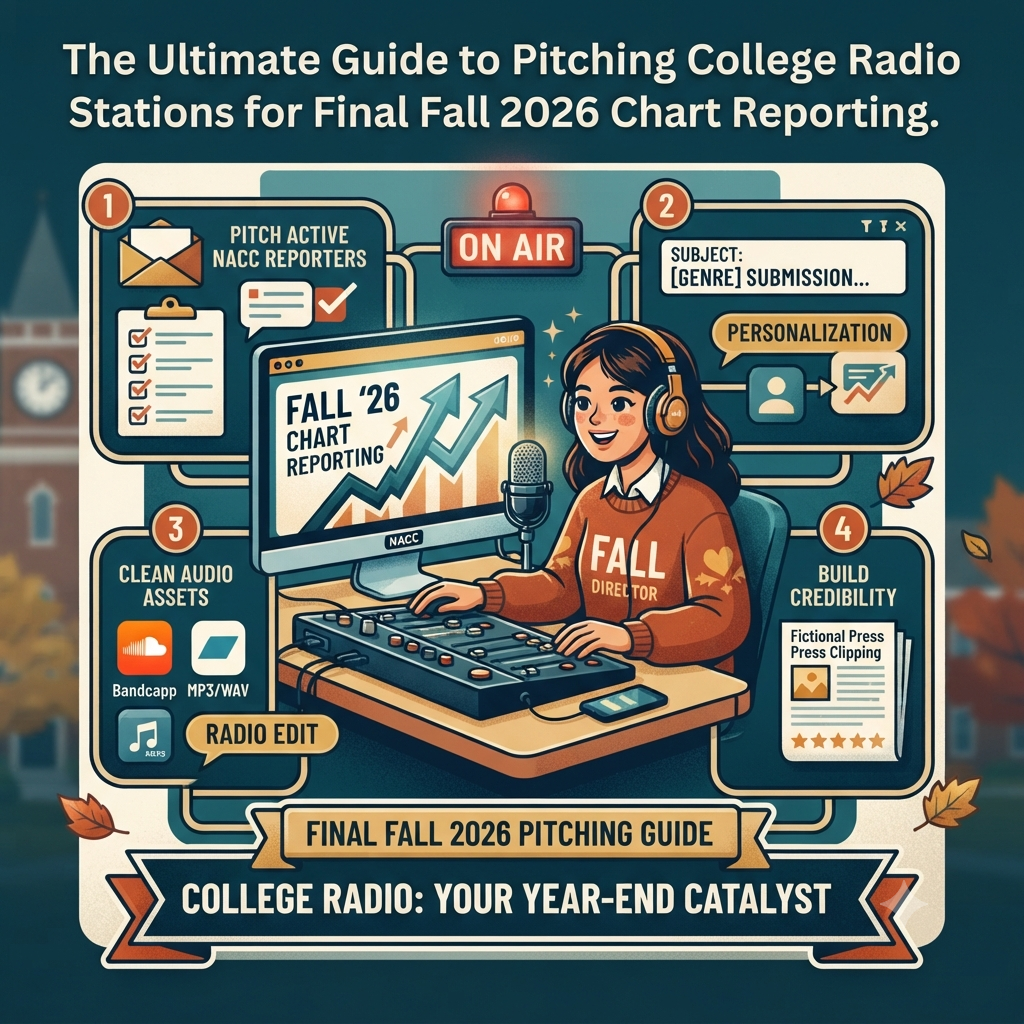
1. Filter for Active NACC and Chart-Reporting Stations First
Do not waste your time pitching stations that are currently off-air for the semester or stations that do not report their data. Look at the current NACC charts, find stations that regularly report their top 30 tracks, and build a targeted spreadsheet. Focus on quality over quantity. Pitching 30 active reporting stations thoughtfully is infinitely more effective than spamming 300 dead inboxes.
2. Nail the Subject Line and Personalization
Music directors sort through an avalanche of emails daily. Your subject line needs to be clean, professional, and instantly informative.
-
The Winning Formula:
[GENRE] Music Submission: [Artist Name] – "[Track Title]" (F/O [Similar Artists]) -
Mention the station call letters if you’ve listened or know they champion your genre. Keeping it concise shows respect for their time.
3. Provide Streamlined, Direct Audio Assets
Never make an MD jump through hoops to hear your music.
-
Include direct links: Provide a clean, unlisted streaming link (SoundCloud or Bandcamp work wonders) alongside a direct download link for a high-quality 320kbps MP3 or WAV file.
-
Radio edits: If your track contains explicit language, always include a clearly labeled radio edit. Stations cannot spin tracks that violate FCC guidelines, and they won’t take the time to ask you for a clean version—they’ll just skip to the next email.
4. Build Instant Credibility with Digital Editorial Proof
Here is the truth about college radio programmers: they love supporting independent music, but they also want reassurance that a release has some weight behind it. When an MD is on the fence about whether to add an unknown indie single to their rotation, having external validation makes all the difference.
To truly stand out from the thousands of submissions hitting campus inboxes during the end-of-semester rush, complement college radio spins with verified digital editorial proof on our music review portal. When your outreach includes professional reviews, thought-out critical analysis, and digital press coverage, it signals to campus programmers that your project is actively moving forward in the industry, making them much more confident about taking a chance on your single.
Timing Your Final Push
If you want to capitalize on final Fall 2026 chart reporting, your timeline needs to be aggressive:
-
Late October / Early November: Build your target station list, verify active NACC reporters, and finalize your radio edits and promotional one-sheets.
-
Mid-to-Late November: Send your initial pitch waves. Avoid the week of Thanksgiving, as many campuses empty out early.
-
Early December: Send a polite, low-pressure follow-up just as students begin hunkering down for final exams. Keep it brief: “Hey [Name], I know finals are kicking off, just wanted to float this final 2026 single your way in case you’re locking in any last rotation adds before break!”
By respecting their academic schedule, offering clean assets, and bolstering your campaign with credible press features, you can turn college radio into one of the most rewarding pillars of your independent release strategy.
CTA Box
Ready to Boost Your Media Profile? Make your music catalog attractive to media outlets, playlist curators, and campus radio programmers. Order a feature via our Music Review Page.