Apple Music Replay 2026 vs. Spotify Wrapped: Converting Alternate DSP Data Into a 2027 Tour Blueprint
Every December, your entire timeline turns into a wall of neon-green and black Spotify Wrapped graphics. Artists post their listener counts, fans flex their top five songs, and for about seventy-two hours, it feels like Spotify is the only music platform on earth.
If you are an independent hip-hop or R&B artist, buying into that illusion is an expensive mistake.
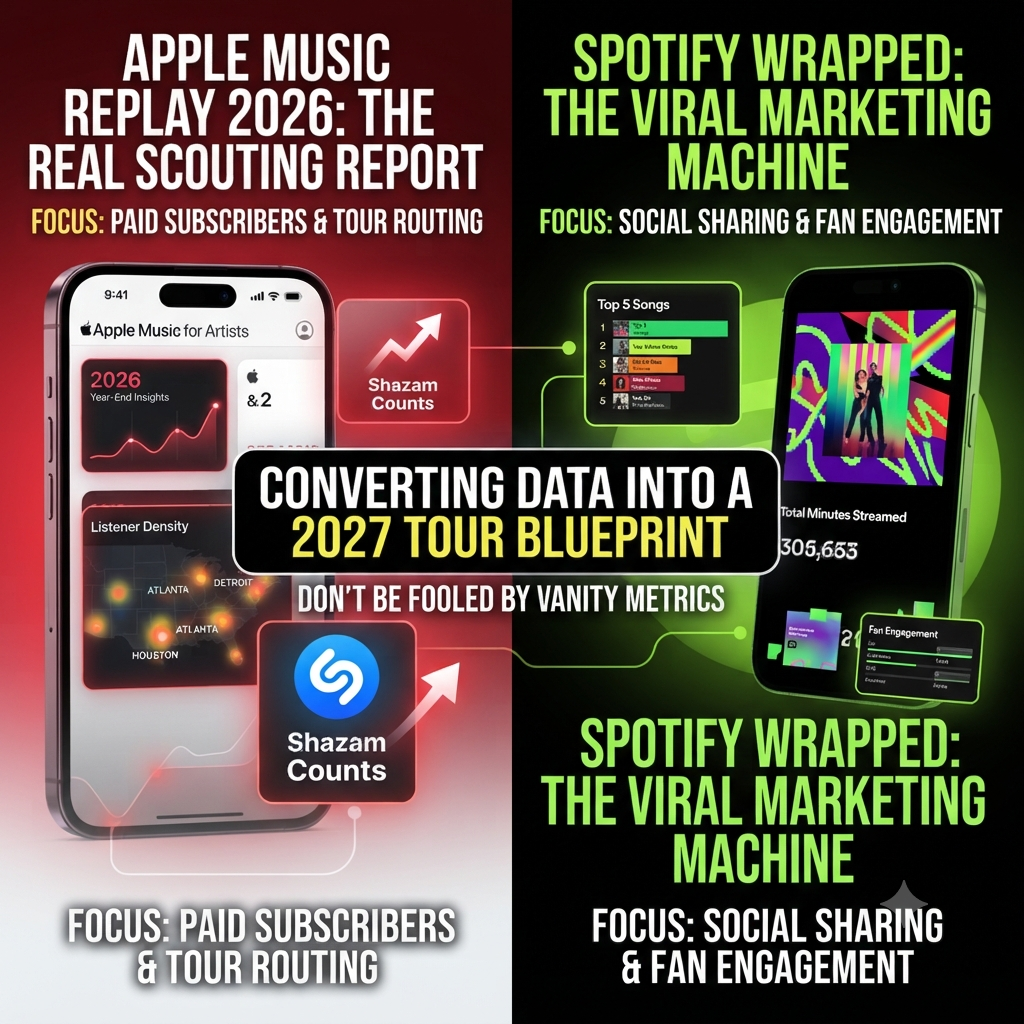
When you actually sit down and compare Apple Music Replay artist data vs. Spotify Wrapped, you realize they serve two totally different purposes. Spotify Wrapped is a brilliant viral marketing machine built for social media screenshots. Apple Music Replay 2026, paired with the backend inside Apple Music for Artists, is a quiet, year-round market research tool that tells you where people are actually spending money on your music.
More importantly, if you are mapping out tour dates for 2027, relying solely on Spotify numbers will send you to the wrong cities. Here is how to pull the real gold out of your year-end Apple Music analytics, spot the urban markets where your fanbase is actually hiding, and turn those numbers into a smart 2027 tour route.
Apple Music Replay Artist Data vs. Spotify Wrapped: What Is the Real Difference?
Most artists treat Apple Music as an afterthought because the year-end social share cards aren’t as flashy as Spotify’s. That is a mistake. When you look under the hood at Apple Music Replay artist data vs. Spotify Wrapped, the mechanics of how each platform collects and reports listener behavior couldn’t be more different.
Why Urban Hip-Hop Hubs Lean Toward Apple Music
Look at national market share charts and you will see Spotify sitting comfortably ahead in total U.S. subscribers. Broad national averages lie to independent artists, though.
Once you zoom in on core hip-hop and R&B metros—cities like Atlanta, Houston, Washington D.C., New York, Los Angeles, Detroit, and Miami—the numbers flip. In these markets, Apple Music routinely holds a larger share of hip-hop streaming than Spotify.
There is a massive financial difference between the two listeners, too. Apple Music does not have a free, ad-supported tier. Every single stream in your Apple Music dashboard comes from someone paying a monthly subscription bill—or someone on a family plan with disposable income. If a listener in Houston or PG County puts your project in their 2026 Replay Top 100, they are far more likely to drop $30 on a concert ticket and buy a hoodie at the merch table than a passive listener who heard you once on a free Spotify shuffle.
How to Pull 2027 Tour Routing Data From Apple Music for Artists
Before you start emailing talent buyers or pricing out a sprinter van for spring 2027, log into Apple Music for Artists on your desktop. Skip the vanity totals on the home screen, head straight into the Measure and Places tabs, and pull these four specific insights.
1. Find Your “Hidden Anchor” Cities in the Places Tab
Open Places and set your date range to cover the full 2026 calendar year. Sort your cities by Average Daily Listeners rather than just raw total plays, then put that list side-by-side with your top cities in Spotify for Artists.
You are looking for mismatches. Maybe Charlotte, Baltimore, or Memphis sits at #22 on your Spotify dashboard because a random workout playlist gave you a temporary spike back in April. Meanwhile, that exact same city is sitting at #5 on Apple Music with consistent daily streams every week of the year.
That is a hidden anchor market. Also pay close attention to suburban clusters right outside major cities—places like Decatur outside Atlanta, or Inglewood and Long Beach outside L.A. Heavy suburban listener density proves locals are actually living with your music, not just tourists passing through downtown.
2. Use Shazam Counts to Spot Real-World Street Heat
Because Apple owns Shazam, your Shazam Count lives right inside your Apple Music dashboard. Think about what a Shazam tag actually represents compared to a passive stream. Nobody Shazams a song while zoning out at their desk. A Shazam means someone heard your track riding in a friend’s car, sitting in a barbershop chair, walking through a clothing store, or standing in a club, and cared enough to pull out their phone to figure out who made it.
Filter your 2026 metrics by Shazam Count and check which cities spiked during the second half of the year. Those are your prime secondary tour markets for 2027. You don’t need to book a 1,500-capacity theater there—book an intimate 250-capacity room while that organic word-of-mouth buzz is still hot.
3. Check Terrestrial Radio Spins Before Pitching Local Promoters
One of the most underrated features inside Apple Music for Artists is its radio tracking. Apple monitors airplay across more than 40,000 terrestrial and digital radio stations globally.
Under your Trends and Places views, check if any local mixshow DJs, college stations, or late-night hip-hop blocks spun your records in 2026. Walking into a booking email with a promoter in Dallas or Philadelphia and saying, “I have 1,400 daily Apple Music listeners in your city and 45 spins on local radio this fall,” carries ten times more weight than bragging about raw global Spotify numbers. Promoters know Apple Music metrics translate to bodies at the door.
4. Separate Album Listeners From Single Streamers
Spotify’s ecosystem is built around individual tracks and algorithmic playlists. Apple Music users still listen to full bodies of work. Notice how Apple Music Replay prominently displays a listener’s Top Albums right alongside their Top Songs.
Dig into your 2026 album play-through rates by city. The cities where fans are spinning tracks four through nine on your EP—not just the lead single—are the cities where you can actually headline a 45-minute set without losing the crowd halfway through.
Turning Year-End Data Into Actual Momentum
Analytics won’t book a tour on their own, and data sitting in a spreadsheet won’t grow your fanbase. The smartest independent artists use their year-end numbers to build a feedback loop between platforms.
Once Apple Music shows you which five or ten zip codes are already riding with your catalog, aim your Q1 2027 rollout directly at those cities. Run low-budget, geo-fenced Instagram Reels and TikTok ads using your 2026 Apple Music Milestone graphics, targeting hip-hop fans strictly within a 25-mile radius of those top hubs. At the same time, don’t neglect the discovery engine on the other side of the fence—you can convert streaming data across all platforms into active listener growth via our independent rap playlist campaigns, using editorial and algorithmic momentum on Spotify to feed new listeners back into your entire catalog.
When you stop treating Spotify Wrapped as the final scoreboard and start treating Apple Music Replay as your scouting report, your entire 2027 strategy changes. You stop guessing where your fans live, stop wasting ad dollars on broad national targeting, and start booking rooms you know you can fill.
Ready to build real cross-platform momentum? Grow your catalog across all major streaming stores. Schedule your push on the Music Submission Portal.