Why Spotify’s Algorithmic Radio Triggers Way Faster Than Discover Weekly (And How to Work It)
Ask almost any independent artist or producer looking at their Spotify for Artists dashboard what their main goal is, and they’ll give you the exact same answer: Discover Weekly.
For years, getting picked up on that Monday playlist drop has been seen as the ultimate sign that you’ve made it into the algorithm. But relying entirely on Discover Weekly can feel like a nightmare. You drop a new track, wait weeks (or months), and watch the stats sit flat while you wonder if the machine is ever going to notice your release.
Here’s what most independent musicians don’t realize: there is a much faster, far more aggressive algorithm running behind the scenes on Spotify that picks up tracks in days, not weeks. It’s called Algorithmic Radio Mode (including Autoplay).
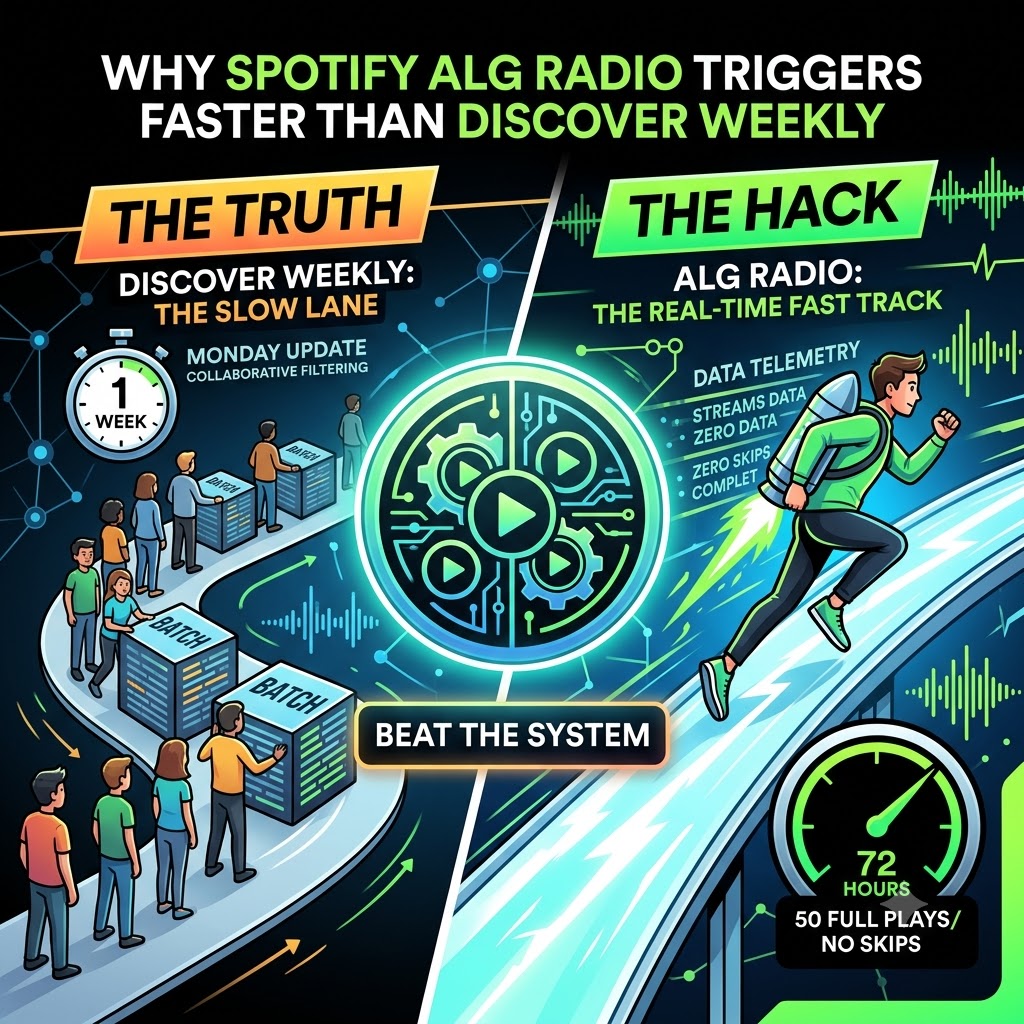
While Discover Weekly operates on a slow, weekly batch-processing system, Spotify’s radio algorithms are built to react in real time. If you understand how the backend telemetry works and feed it the right signals early on, you can kickstart this radio engine within 72 hours of dropping a song.
Let’s look under the hood to break down why Spotify Radio moves so much faster than Discover Weekly—and how you can use this knowledge to drive serious streaming numbers.
Batch Processing vs. Real-Time Telemetry: How Spotify’s Engines Actually Work
To understand why Radio triggers so fast, you have to look at how Spotify processes user data behind the curtains. The platform doesn’t treat every feature the same way.
Discover Weekly: The Heavy, Slow-Moving Machine
Discover Weekly runs on what data engineers call collaborative filtering and matrix factorization. In simple terms, it tries to solve a massive math puzzle across Spotify’s entire user base: “Listeners who like Artist A and Track B also tend to listen to Track C.”
Because analyzing hundreds of millions of user accounts against tens of millions of songs takes an enormous amount of computing power, Spotify doesn’t calculate this live. Instead, it runs these heavy algorithms on a weekly batch schedule. The calculations process over the weekend, and the playlists update every Monday morning.
Even if your track goes viral on a Tuesday, Discover Weekly’s machine learning models literally cannot factor that new data in until the next scheduled pipeline run.
Spotify Radio & Autoplay: The Real-Time Feedback Loop
Spotify Radio and Autoplay serve a completely different purpose for the listener: keeping the sound going without interruption.
When a user finishes an album, a single, or a custom playlist, Spotify doesn’t want dead silence. It immediately fires up Autoplay or a Radio station based on the song that just ended. To make that transition feel natural, the system can’t wait until next Monday to decide what to play next. It relies on low-latency, real-time telemetry.
This backend system watches immediate micro-interactions:
-
How many seconds did a user listen before skipping?
-
Did they play the song all the way through?
-
Did they immediately loop it or replay it?
-
Did they save it or add it to a personal playlist?
When your song starts showing strong, positive signals across these live metrics, the algorithm flags it as an “anchor track.” Within hours, Spotify starts testing it in the background of other people’s automated radio streams.
The 72-Hour Trigger: 50 Full Plays, Zero Skips
So, what does it take to actually catch the backend’s attention?
When analyzing real streaming behavior and backend telemetry data, a clear milestone keeps popping up:
Racking up 50 consecutive full-plays with zero skips initiates algorithmic track “Radio” mode within roughly 72 hours.
Why does this specific milestone matter so much to Spotify’s code? It comes down to three major signals:
1. High Completion Rates (>90%)
Spotify treats a complete play-through as a massive vote of confidence. When someone listens to your song from the first second to the last, the system logs that as high-intent engagement. It tells the recommendation engine that the track actually held the listener’s attention.
2. Zero Skips as the Ultimate Quality Filter
The skip button is the strongest negative signal you can give the algorithm. A quick skip tells Spotify, “This song didn’t fit the vibe, don’t play this again.” Conversely, going through dozens of sessions without a single skip signals that your track seamlessly matches what those listeners want to hear.
3. Stream Velocity
Spotify tracks how fast engagement builds up over short timeframes. When 50 unique or high-intent listeners stream your song completely without skipping inside a tight 72-hour window, the backend flags your track as a high-confidence match for that style of music.
Instead of waiting for a manual or weekly update, the system starts quietly dropping your song into auto-generated radio queues for listeners with similar tastes.
How to Trigger Spotify’s Radio Engine for Your Next Release
Getting those first 50 clean, full plays with zero skips can be tough if you’re releasing music without an existing audience. If you share your track with casual friends who hit play for 10 seconds and skip, you actually hurt your algorithmic chances right out of the gate.
To trigger this feedback loop, you need to get your release in front of dedicated, highly engaged listeners who are guaranteed to stream the whole song.
One of the cleanest ways to do this is through strategic playlisting. When you trigger automatic algorithmic radio queues by driving high-retention listener sessions using our targeted rap playlist placements, you give Spotify’s backend exactly the data it wants to see. Placing your track on active, genre-focused playlists ensures that real hip-hop heads listen to the full track without hitting skip, kicking off the 72-hour telemetry loop naturally.
Stop Waiting for Monday
The Spotify algorithm isn’t a secret black box—it’s just a mirror reflecting user behavior.
Discover Weekly is still a great milestone to hit long-term, but it shouldn’t be your only release strategy. If you focus on early stream velocity, protecting your skip rate, and driving high-completion sessions during your release window, you can trigger Spotify’s real-time radio engine before the weekend even starts.
Focus on retention over raw play counts, line up targeted placements, and let the real-time backend telemetry do the heavy lifting for you.