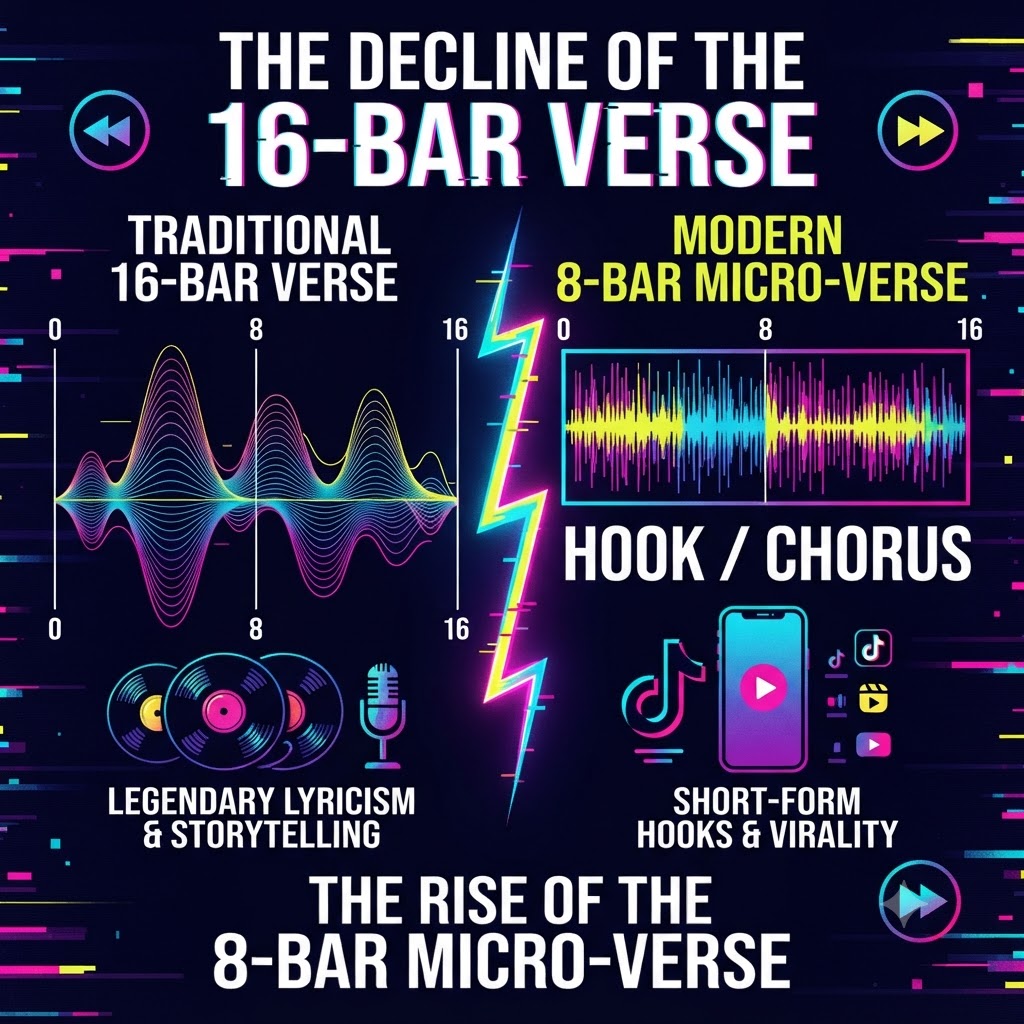
The Death of the Long Verse: Why 8-Bar Micro-Verses Are Quietly Taking Over the Radio
If you’ve been listening to pop radio, scrolling through TikTok, or just keeping up with the charts over the last couple of years, you’ve probably felt a subtle shift in how songs are put together. Tracks feel faster, punchier, and somehow over before you even realize you’re halfway through them.
For decades, the standard blueprint for a pop, hip-hop, or R&B track was simple: you set the mood, you drop a solid 16-bar verse, hit a pre-chorus, and explode into the hook. It was the golden rule of songwriting. It gave artists enough room to breathe, tell a story, switch up their cadences, and flex their lyrical muscles.
Lately, though? That 16-bar verse is disappearing.
In its place, we’re seeing the rise of the 8-bar micro-verse. Songwriters, producers, and major labels are cutting their verses right down the middle, shaving off fat to get to the chorus as quickly as humanly possible.
So, what happened to the traditional verse? Why is the entire music industry suddenly obsessed with brevity? And is this shorter, snappier era of music a stroke of marketing genius, or is it killing the art of storytelling? Let’s dig into it.
The Anatomy of the Shift: How We Got From 16 Bars to 8
To understand why 8 bars has become the new industry standard, it helps to look at how song structures used to operate. For generations, the anatomy of a hit followed a comfortable, predictable roadmap:
-
The Intro: Setting the sonic landscape (5 to 10 seconds).
-
Verse 1 (16 Bars): The setup. This is where the artist introduces the theme, paints a picture, and hooks the listener with clever rhymes.
-
Pre-Chorus: Building the tension.
-
The Chorus/Hook: The emotional and melodic payoff.
-
Verse 2 (16 Bars): Expanding on the story or offering a fresh perspective.
-
Bridge & Outro: The emotional climax and wrap-up.
It worked for Elvis, it worked for 90s hip-hop, and it worked for early 2000s bubblegum pop. It gave listeners a sense of narrative progression.
Today? That second verse is often compressed into a breathless 8 bars—or sometimes skipped altogether in favor of jumping straight back into a repeated chorus. Artists aren’t abandoning lyrics entirely, but they are treating them like a teaser trailer rather than the main feature.
The Elephant in the Room: How Short-Form Video Rewrote the Rules
We can talk about changing artistic tastes all day long, but at the end of the day, the music industry responds to structural incentives. And right now, the biggest incentive on the planet is algorithmic virality.
Platforms like TikTok, Instagram Reels, and YouTube Shorts have completely upended how music is consumed, discovered, and monetized. Here is how that translates to the studio:
1. The Brutal 3-Second Rule
Attention spans are shorter than they’ve ever been. When users are swiping through an endless vertical feed, they make a split-second decision on whether to stay or scroll. If a song takes 40 seconds to reach its main hook, the algorithm registers a low retention rate and buries the content. Producers know they have to front-load the catchy parts immediately. Cutting the verse in half guarantees that the chorus hits faster, keeping listeners hooked before fatigue or boredom sets in.
2. Engineering for Visual Hooks
Modern songwriters aren’t just writing for headphones anymore; they are writing for video content. An 8-bar verse creates a specific, bite-sized window that content creators can easily pair with a dance challenge, a transition, or a meme. By keeping the verse tight and punchy, it becomes the ultimate audio backdrop for a 10-second video clip.
3. The Math of Streaming Economics
Let’s be honest: streaming platforms pay per play, and a “play” usually only requires a listener to stick around for 30 seconds. In the streaming era, shorter tracks mean higher turnover. If an artist can drop a track that clocks in under two and a half minutes with zero dead air, fans can loop it twice in the time it used to take to listen to one sprawling 90s epic. More loops equal more streams, and more streams equal better chart placement.
The Creative Trade-Off: Pros and Cons of the Micro-Verse
Of course, every industry trend comes with a price. While the micro-verse is a masterclass in modern commercial efficiency, it forces artists to compromise on depth.
The Pros: Why It Works
-
Instant Gratification: Tracks feel high-energy and immediate. There’s no downtime or “filler” material.
-
Masterful Efficiency: It forces lyricists to be incredible editors. Packing a punch, a narrative arc, and clever wordplay into just 8 bars takes serious skill.
-
High Replay Value: Because the songs move so fast, they often feel hypnotic on repeat listens.
The Cons: What We Lose
-
The Death of Complex Storytelling: It is nearly impossible to build a rich narrative, develop complex characters, or drop intricate multi-syllabic rhyme schemes in a tiny 8-bar window.
-
The “Fast Food” Feel: Some critics argue that modern radio edits feel disposable. When every song rushes to the chorus, they start to blur together, lacking the distinct emotional weight of classic anthems that took their time building up.
Is the Traditional 16-Bar Verse Actually Dead?
Before we completely write off the long verse as a relic of the past, it’s worth noting that music is cyclical.
While the 8-bar micro-verse undeniably rules mainstream pop radio and viral charts, a strong counter-culture is bubbling right beneath the surface. Underground hip-hop, indie rock scenes, and dedicated album cuts still champion long-form lyricism. Fans who crave substance over quick TikTok hooks are actively pushing back against the over-streamlining of music.
Furthermore, many smart artists are learning to play both sides. They’ll release a punchy, 8-bar micro-verse edit for streaming platforms and social media algorithms, while preserving the extended, traditional 16-bar version on the physical vinyl or the deluxe album drop. It’s a clever compromise: satisfy the algorithm to get discovered, but feed the purists to build a lasting legacy.
Where Do We Go From Here?
The music business has always evolved alongside technology—from the strict 3-minute limits of early vinyl records to the wild west of the MP3 era, and now into the hyper-fast world of short-form video algorithms. The 8-bar micro-verse is simply the logical conclusion of a society that values speed, convenience, and instant connection.
Whether you love these bite-sized radio edits or miss the sprawling storytelling of the past, one thing is certain: the rules of the hit song are never set in stone.