Choosing Your Angle: Blog Features vs. Interviews vs. Track Reviews in Music Journalism
If you’ve ever tried to run a music PR campaign, you already know that dropping a great song is only half the battle. The real trick is knowing how to talk about it, package it, and pitch it to blogs and tastemakers without getting lost in the noise.
Not all music coverage is built the same way. A quick blurb about a single does a completely different job than a deep-dive interview or an album-length feature. If you want to make the most of your release budget and time, you have to match the right press format to the exact stage of your rollout.
Let’s break down how blog features, interviews, and track reviews actually work in the real world—and how to use them to your advantage.
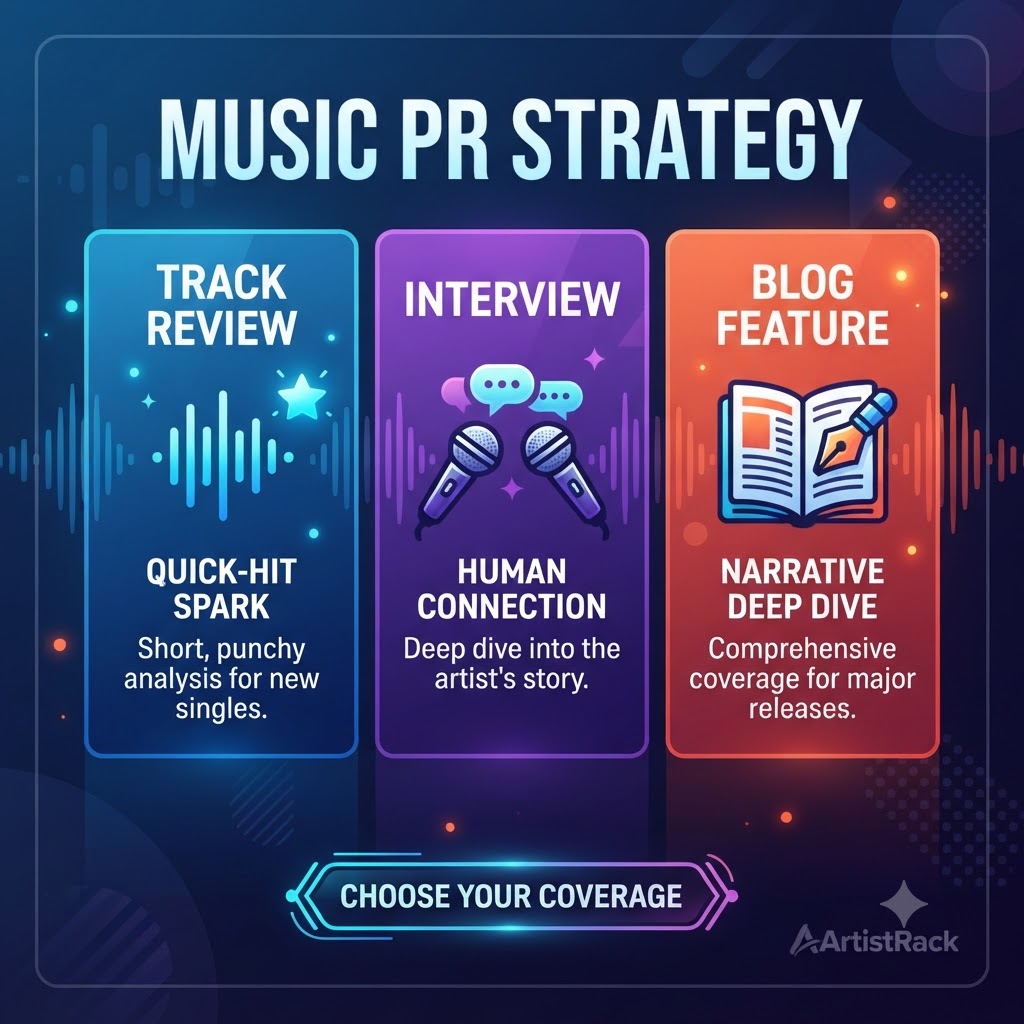
1. The Track Review: The Quick-Hit Spark
Think of a track review as the initial ignition point for a single. It’s concise, punchy, and focused entirely on the song right in front of the writer. Instead of unpacking your whole life story, a good review zooms in on the production choices, the vocal delivery, the groove, and how the track hits on first listen.
-
The Vibe: Usually short and sharp (roughly 300 to 500 words), giving readers a snapshot of why this specific song deserves a spot in their rotation.
-
The Goal: To deliver immediate social proof, create a quick wave of excitement, and give casual listeners an easy entry point to your sound.
-
When to Use It:
-
Right around release day or during the pre-save push.
-
When you need quick editorial backing to help build playlist momentum.
-
To test the waters with a standalone single before dropping a bigger body of work.
-
If you just need a fast, effective injection of hype and search visibility for a new drop, a sharp track review gets straight to the point.
2. The Interview: The Human Connection
People don’t just fall in love with audio files; they fall in love with people. An interview shifts the lens away from just the music and puts the focus squarely on you—your creative quirks, your background, the late nights in the studio, and the story behind the art.
-
The Vibe: A direct conversation, whether through a traditional Q&A or a narrative profile, that lets your personality and voice actually come through.
-
The Goal: To build real audience loyalty, humanize your brand, and prove to the industry that there’s substance behind the hype.
-
When to Use It:
-
Right in the middle of a rollout when fans are craving behind-the-scenes content.
-
Alongside a major milestone like an EP release or a tour announcement.
-
When you want to cement your identity as an artist with a distinct point of view.
-
Music is crowded. An interview gives your supporters a reason to root for you as a person, turning casual listeners into lifelong fans.
3. The Blog Feature: The Narrative Anchor
A blog feature is the heavyweight piece of your campaign. Where reviews are quick snapshots and interviews are conversations, a feature is an immersive, multi-paragraph story. It connects the dots between your music, your aesthetic, your backstory, and your cultural footprint.
-
The Vibe: Rich, long-form editorial writing (usually 600+ words) designed to contextualize who you are as an artist.
-
The Goal: To create a permanent digital footprint, boost your long-term SEO, and serve as the anchor piece of your Electronic Press Kit (EPK).
-
When to Use It:
-
Major project rollouts like albums, mixtapes, or defining EPs.
-
When you’re re-introducing yourself after a rebrand, a name change, or a hiatus.
-
When you want gatekeepers, booking agents, and industry folks to see that your project has serious editorial weight.
-
Features give you the kind of lasting presence online that makes people take your career seriously from the moment they Google your name.
Matching the Format to Your Rollout
Timing is everything. Pitching a massive, multi-page biographical feature for a quick club bouncer usually doesn’t work out. At the same time, relying solely on a brief review for a debut album means leaving a ton of great storytelling on the table.