How Music Blogs Actually Build Your Google Knowledge Panel (And Why It Matters)
You search for a band, and boom—there it is on the right side of your screen. Tour dates, album covers, a bio, and social links, all neatly packaged in Google’s Knowledge Panel.
To a fan, it looks automatic. But if you’re an independent artist, you probably already know it’s not magic. It can actually be incredibly frustrating to put out great music, yet still feel like you don’t “officially” exist on Google.
The truth is, search engines don’t just hand out those sidebars because you asked nicely. They need proof that you are who you say you are. And more often than not, that proof is built on the back of independent music blogs.
Here is a look behind the curtain at how Google actually uses music reviews to verify who you are and build your digital footprint.
1. The “Who is Who?” Problem
Think about how messy the internet is. If an indie-pop singer and a 90s punk band happen to share the exact same name, how does Google know which one just dropped a new single last Tuesday?
Search engines solve this using Entity Recognition. Instead of just reading words, they try to understand the actual people, places, and concepts behind them.
Sure, your official website and Spotify bio are great starting points, but to an algorithm, they are biased. Anyone can build a landing page and claim to be the next big thing. Google wants independent, third-party proof before it permanently stamps your discography into its Knowledge Graph. That is exactly where music bloggers step in.
2. Connecting the Dots: How Reviews Feed the Algorithm
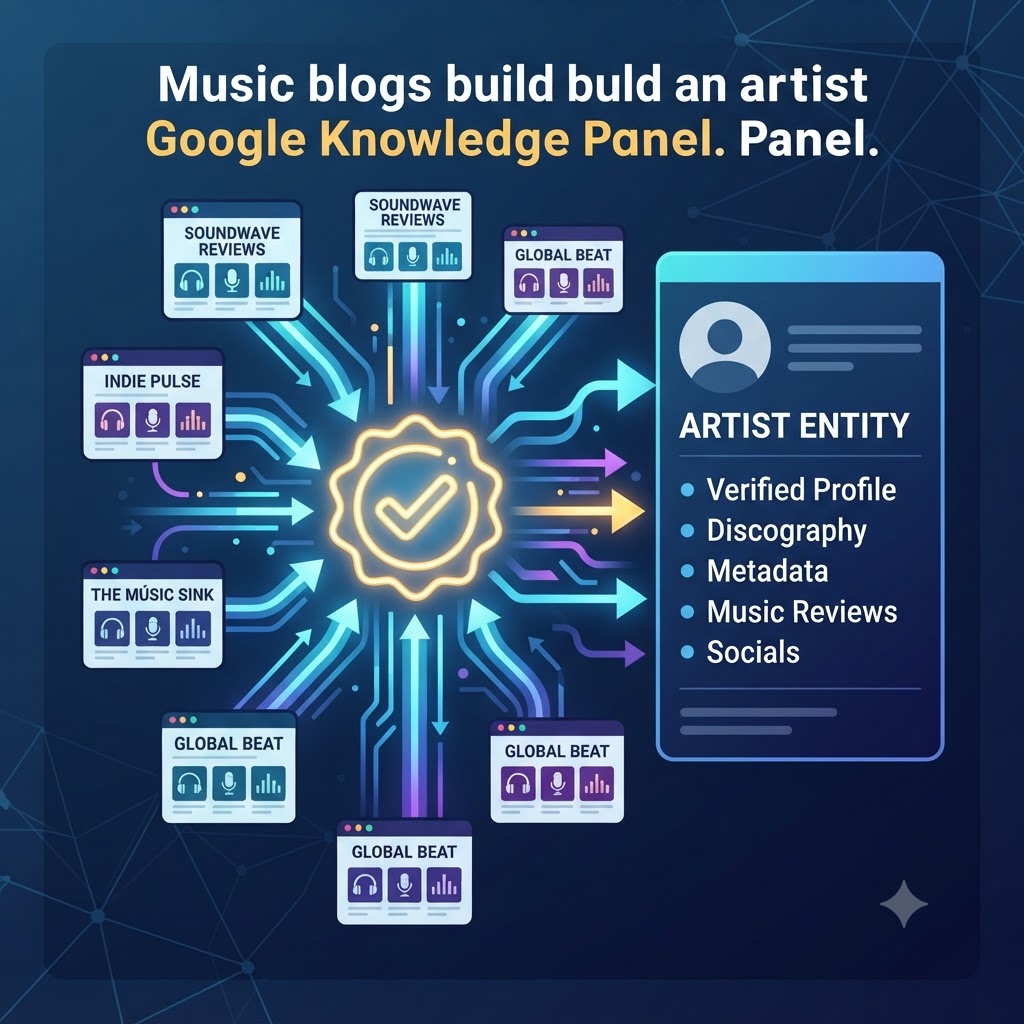
When a blog writes a review, does an interview, or premieres your track, Google’s web crawlers are reading between the lines. They aren’t just looking for keywords; they are actively fact-checking your career.
Here is what they are looking for:
-
Contextual Clues: If three different music blogs review your EP and associate your name with a specific genre, hometown, and record label, Google connects those data points. You stop being a random string of text and start becoming a verified entity.
-
Fact-Checking Your Discography: Bots cross-check the tracklists and release dates mentioned in a blog review with the metadata on streaming platforms. When a third-party writer confirms your album dropped on a specific date, it proves your official metadata is accurate.
-
Proving You Actually Matter: Google tracks how often you’re talked about. One random forum post won’t do much. But consistent features across real, established music sites? That tells the algorithm you have actual, real-world traction.
Once Google sees enough independent blogs agreeing on your facts, it finally trusts the data enough to build and display your Knowledge Panel.
3. The Social Media Trap
A lot of emerging artists put 100% of their energy into TikTok or Instagram and completely ignore the rest of the web. While you definitely need socials to connect with fans, relying on them for your search presence is a massive mistake.
Social platforms are walled gardens. They change constantly, and they don’t give Google the structured data it needs to figure out your career history. If your entire existence is tied up in a social feed that could disappear or change its algorithm tomorrow, you haven’t really built a foundation.
You need to step outside the feed and establish your searchable digital identity. Securing a professional, dedicated presence builds permanent search authority. When Google sees widespread blog coverage pointing back to you, it stops seeing you as a fleeting social media trend and starts seeing you as a permanent fixture in the music industry.
Take Control of Your Narrative
Getting your music recognized by search algorithms requires more than just uploading a track to a distributor. It requires an intentional, indexable digital footprint that web crawlers can actually verify.